


Bottom line
1. Cheap money is becoming the moat. Two companies running the same GPUs can pay 7% or 15% to finance them. On $1B of equipment, that’s $80M a year, enough to decide who can cut prices and who has to raise them.
2. What you pay to borrow depends on who pays your rent. Big tech borrows at about 0.6 percentage points over U.S. government bonds. Neoclouds, the newer GPU rental companies like CoreWeave, pay 8 to 12 points over, close to the riskiest junk bonds.
3. “CoreWeave pays 15%” is wrong about cost and right about risk. Only 4% of CoreWeave’s debt costs 15%, and its average rate is 8.4%. But its bonds now trade like the riskiest junk.
4. Watch the next big GPU loan backed by a big tech contract. If it gets done near this year’s rates, October was a scare. If lenders back away, the companies that most need money will have trouble getting it.
Who pays the rent sets the price
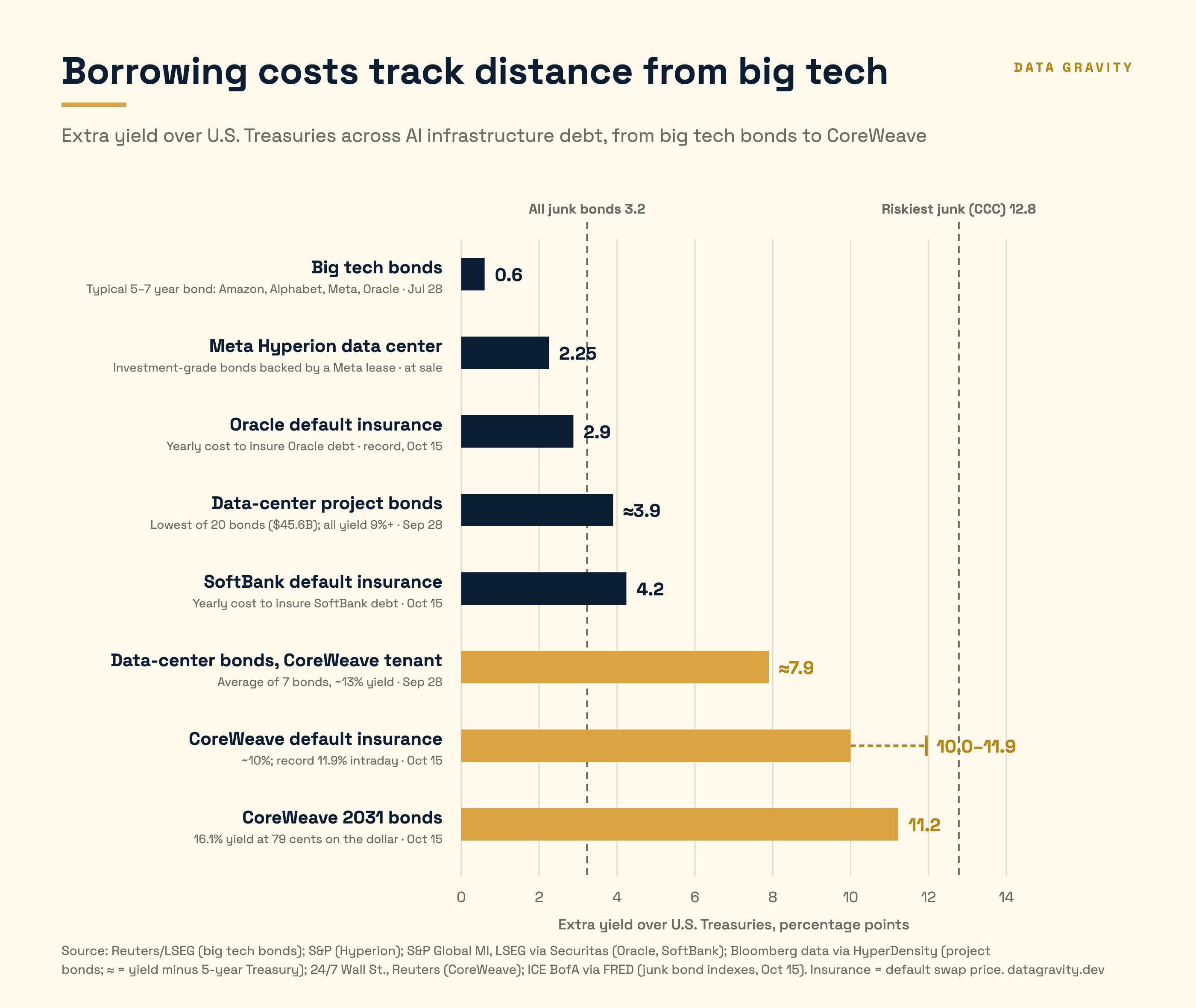
Everyone on this chart is paying for the same things: buildings, power and chips. The price of the money changes with who pays the rent.
Amazon, Alphabet and Meta borrow in their own names at well under 1 point over government bonds. Meta’s Hyperion data center in Louisiana is one step out. A separate company owns the building and leases it to Meta, and that company borrowed $27B against the lease at 2.25 points over, about twice what Meta pays directly. Lending against one building and one lease costs more than lending against all of Meta.
Next come companies that sit between big tech and the hardware. S&P cut Oracle in July to its lowest investment-grade rating, the last step above junk, and the cost of insuring its debt against default hit a record on October 15. Bonds that fund single data centers yielded at least 9% at the end of September, even with Amazon or Nvidia as the tenant.
At the far end are the neoclouds. Data-center bonds with CoreWeave as the tenant averaged about 13%. CoreWeave’s own bonds trade 11 points over government bonds. The chips are the same all the way across. The tenant sets the price.
October: rates hit the safe end, fear hit the risky end
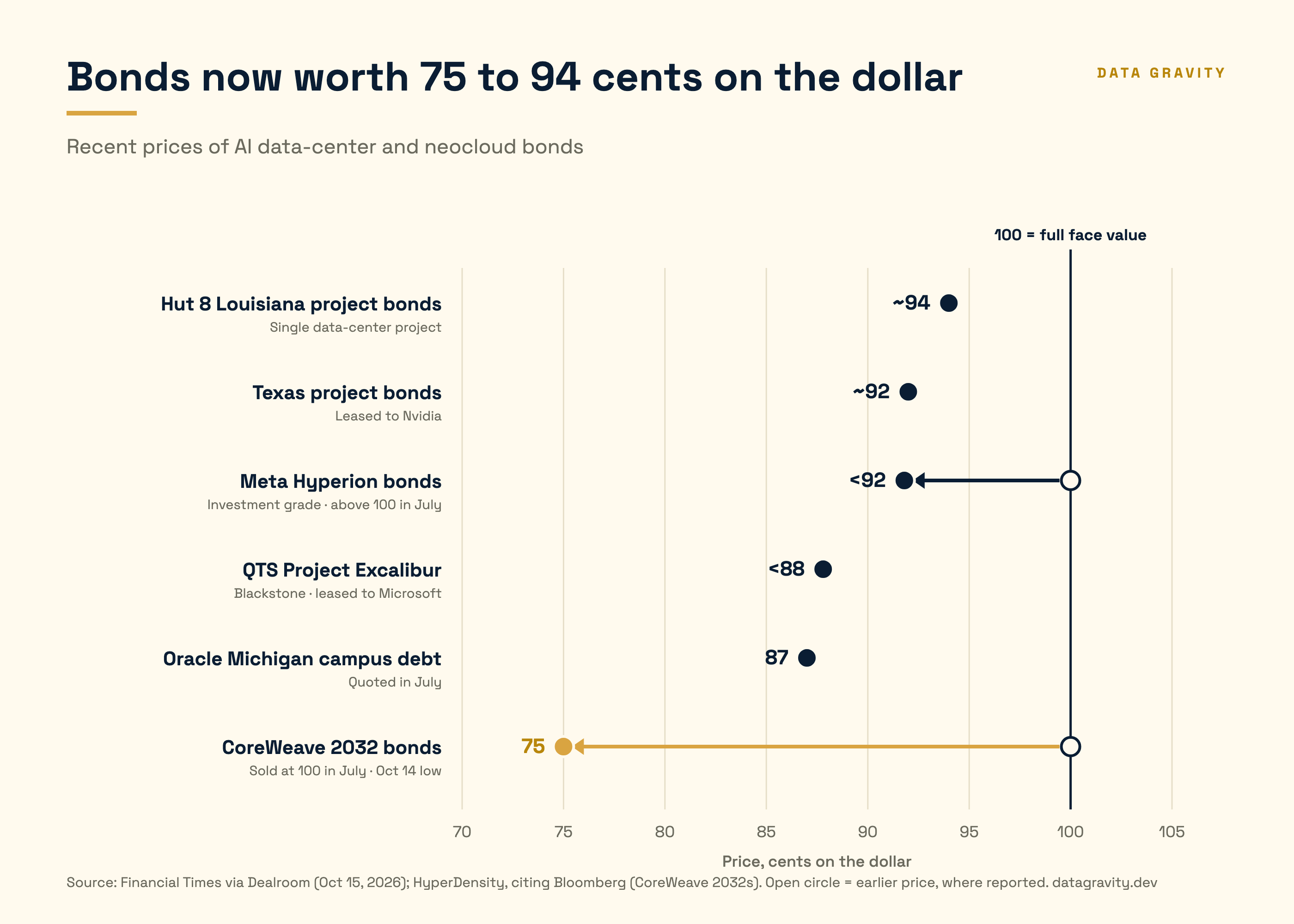
Two different things pushed these prices down. The first was interest rates. The 10-year Treasury yield closed at 5.31% on October 5, up from 3.97% a year earlier and the highest since 2002, and the Fed raised rates in September. Big tech also sold $194B of bonds by early July, more than in all of 2025, so buyers had plenty of supply. When rates rise, existing bonds lose value, and long-dated ones lose the most.
That explains most of what happened at the safe end. Hyperion’s bonds traded above 100 cents on the dollar in July and are just under 92 now. By my rough estimate, higher rates account for about half of that drop. Bonds on buildings leased to Nvidia and Microsoft trade in the high 80s to low 90s. The tenants are fine.
The second thing was fear about getting paid back. CoreWeave sold its 2032 bonds at 100 in July. They hit 75 on October 14. Higher rates explain only about 3 of those 25 cents. The rest is investors pricing in the chance that CoreWeave can’t pay.
Some companies have to keep borrowing
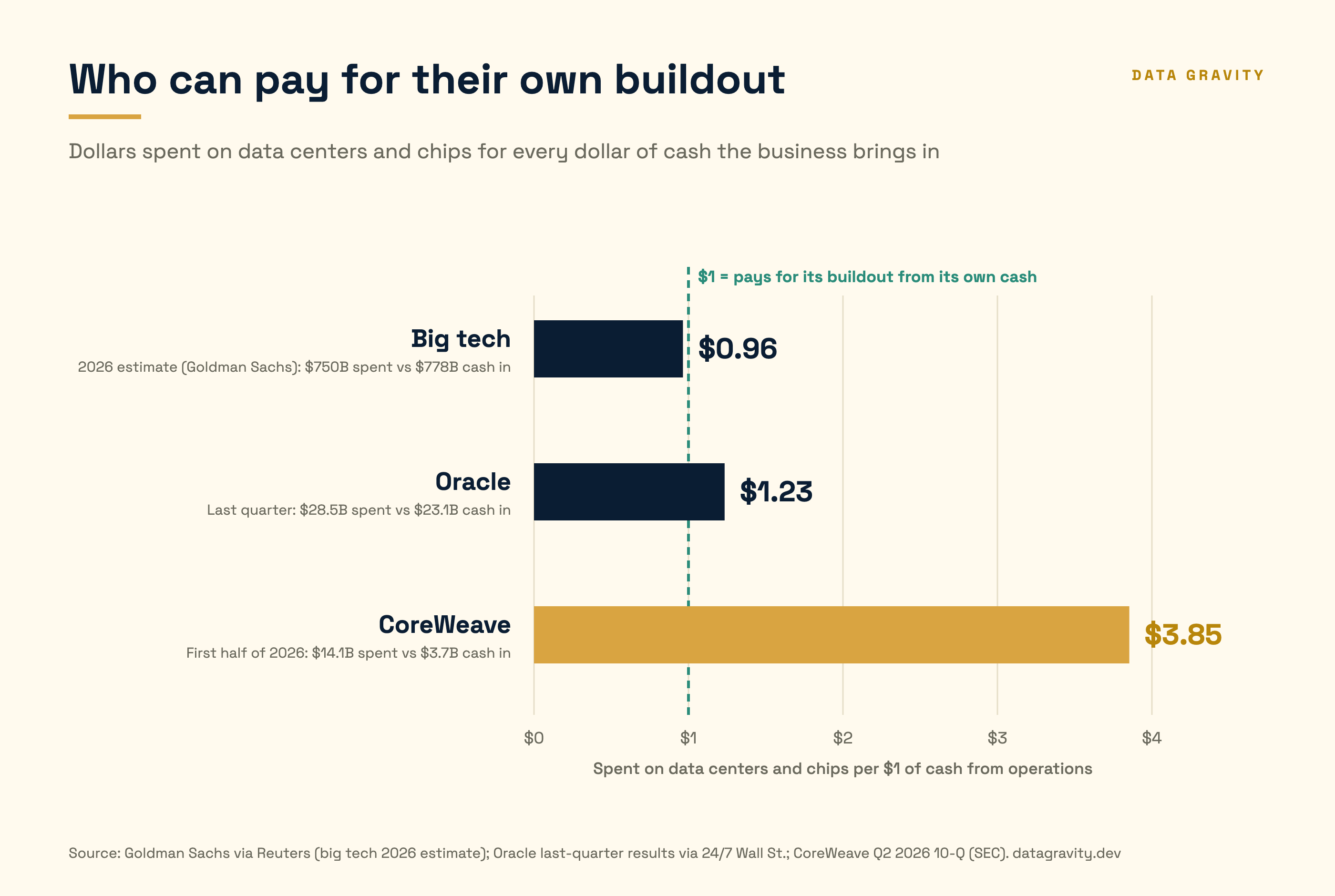
The market is also sorting companies by how much outside money they need. Big tech spends about 96 cents on data centers and chips for every dollar its businesses bring in. It borrows because borrowing is cheap, not because it has to. Oracle spent $1.23 per dollar last quarter and plans to raise about $40B of debt and new stock this fiscal year.
CoreWeave spent $3.85. It put $14.1B into data centers and chips in the first half against $3.7B of cash from its business, and borrowed the difference. Its plan of up to $39B for the year implies as much as $25B more in the second half. Even if its cash flow doubles, it needs to raise $17–21B in six months. A company in that position feels it first when lenders get nervous.
CoreWeave: wrong about cost, right about risk
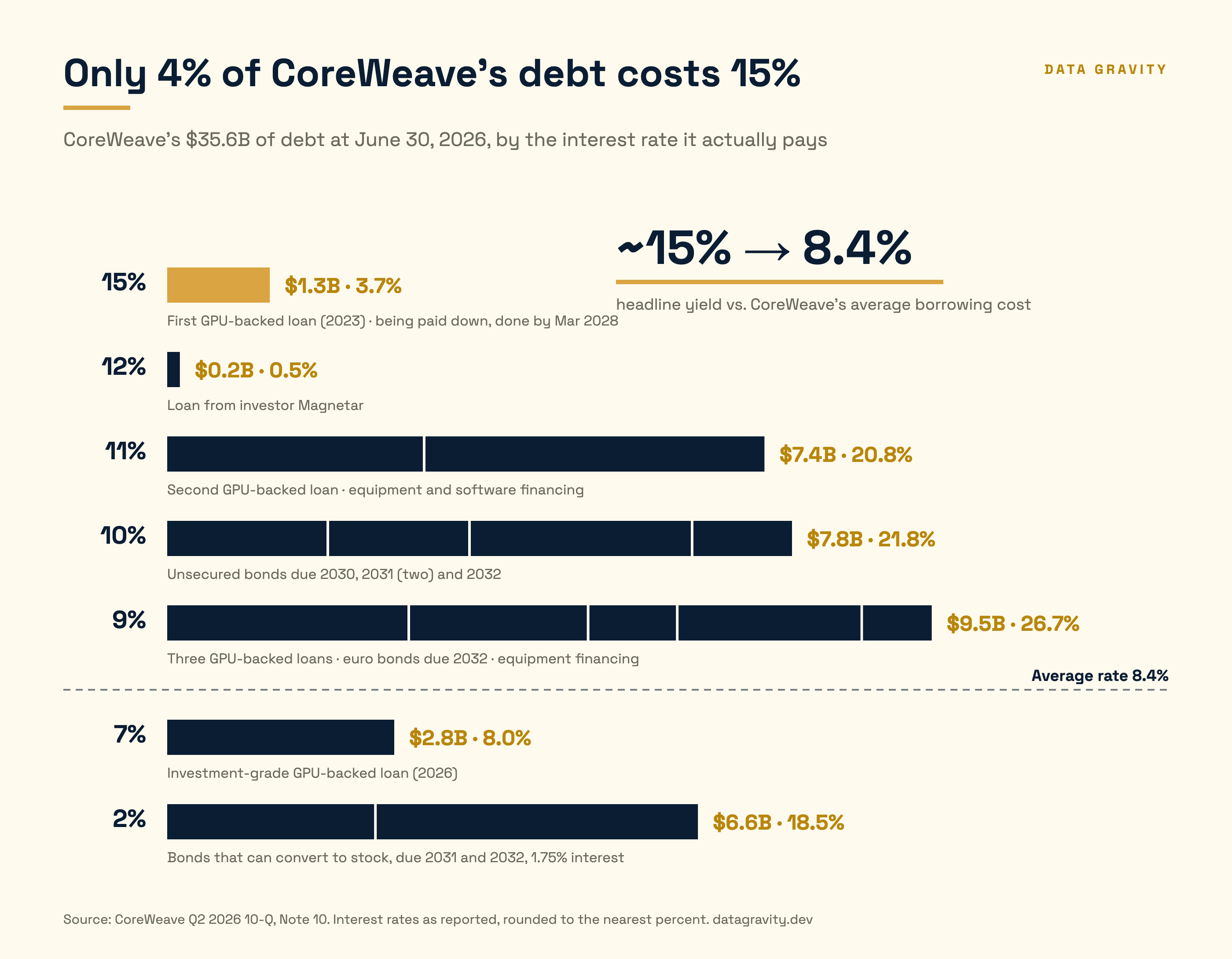
The headline gets the cost wrong. Of CoreWeave’s $35.6B of debt, exactly one loan costs about 15%: its first GPU loan from 2023, which I wrote about in How the GPU Became Collateral. It’s down to $1.3B and will be paid off by March 2028. Across all its debt, CoreWeave pays an average of 8.4%, about $3.0B a year. Its bonds carry fixed rates of 8.5–9.75% and don’t come due until 2030–2032. The 15–16% in the headlines is what CoreWeave would pay to borrow new money today.
The headline gets the risk right. On October 15, CoreWeave’s 2031 bonds traded at about 79 cents on the dollar. S&P rates them as mid-tier junk, but they trade next to the riskiest junk. The cost of insuring CoreWeave’s debt against default hit a record 11.9% a year. S&P expects bondholders would get back only 10 to 30 cents on the dollar if it failed. Put those together and the market price works out to about a 50% chance of default within five years. That’s a price, padded by fear and this week’s selling, not a forecast.
The pressure point to watch is $6.6B of bonds that turn into stock only if CoreWeave’s shares reach $119.60. The stock closed at $65.78 and $69.69 on October 14 and 15. If it stays near there, those bonds will have to be paid back in cash or replaced with new debt. Replacing them and CoreWeave’s other bonds at 15% would add about $1.45B of interest a year, roughly 14% of its current annual revenue.
Same company, 7% to 16%
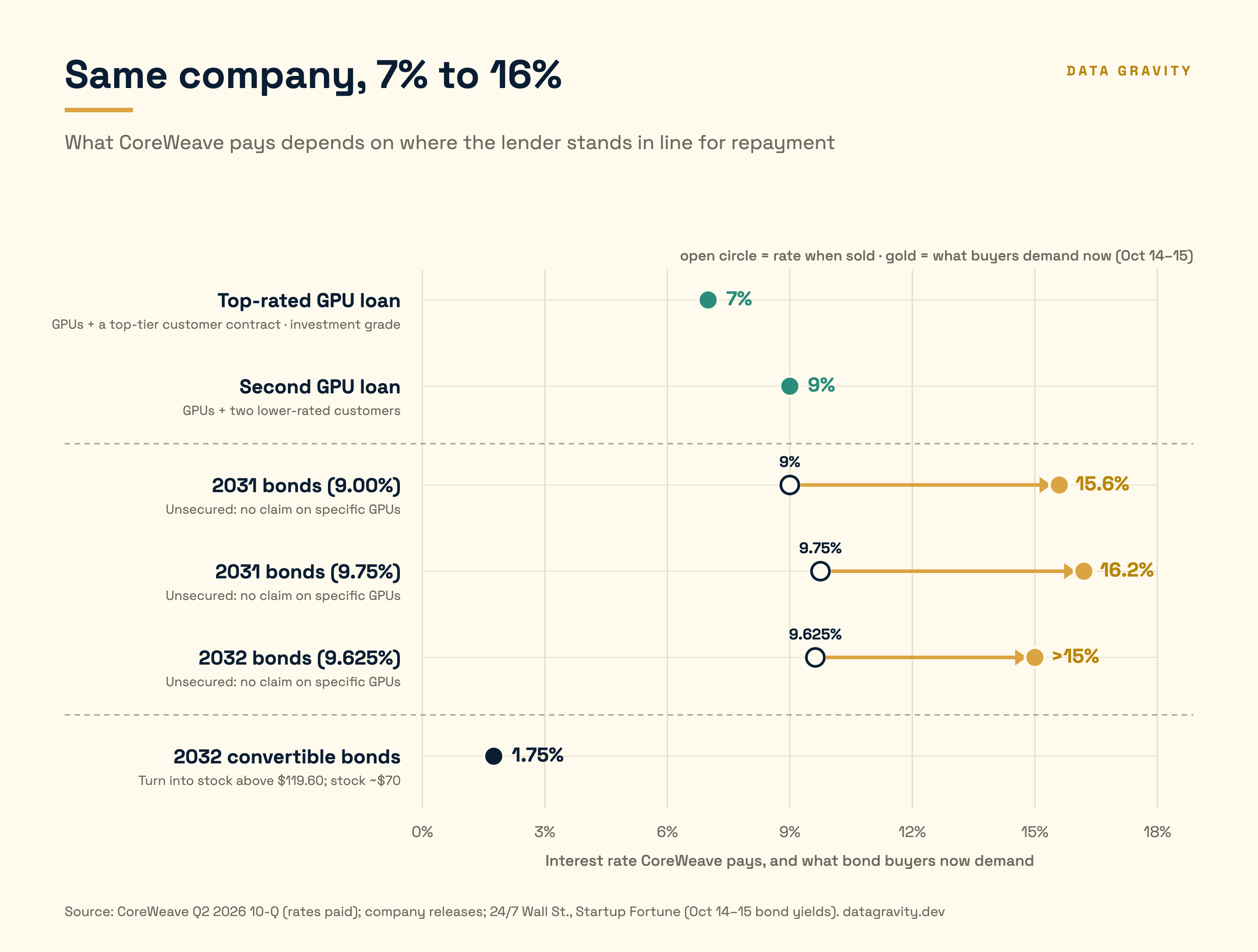
CoreWeave’s cheapest loan costs about 7% and has an investment-grade rating. It works like Hyperion: the GPUs and a contract with a top customer sit in a separate company, and the lenders get paid first from that customer’s payments. A similar loan backed by two weaker customers costs about 9%. CoreWeave’s regular bonds have no claim on any specific GPUs or contracts. They were sold at 9–9.75% this spring, and buyers now want 15–16% to hold them. CoreWeave still pays the original 9–9.75%. The higher number is what a buyer earns by purchasing the bonds at a discount.
The difference is the order of repayment. At June 30, $18.9B of GPU loans and equipment financing stood ahead of $16.6B of regular bonds. Co-founder Brannin McBee told the FT that CoreWeave wants an investment-grade rating to unlock “unlimited” money. That’s the right move for CoreWeave, and it’s also why its bonds keep falling. Each new top-rated loan takes the best contracts, which leaves less for the bondholders at the back of the line.
Cheap money is the moat
Put two companies side by side with the same GPUs and the same customers. Company A finances $1B of equipment at 7%. Company B pays 15%. B pays $80M more in interest in the first year, and about $200M more over four years if both pay their loans down evenly.
That money comes out of pricing. GPU rental prices have already swung from about $8 an hour in early 2024 to $1.70 in October 2025 and back to about $2.35 this March. The company with cheap money can cut prices and still earn a return. The one with expensive money can’t match it without losing money on every contract. When the market turns, the first keeps building and the second sells assets or raises money at the worst time.
Demand isn’t the issue. Open models alone went from 7% to 56% of the usage on Vercel’s AI Gateway between December and August. But lenders don’t lend against usage. They lend against signed, multi-year contracts with customers who can pay. Demand can keep growing while the companies supplying it get into financial trouble.
What this means
If you’re building compute, your customers set your borrowing cost. With a contract from a big tech customer, GPU loans this year priced around 7%. Without one, smaller neoclouds have been quoted roughly 12–13%. Sign the contract that makes the GPUs financeable before you buy them.
If you invest in infrastructure startups, judge the financing plan as hard as the technology. Ask who the anchor customer is, how strong its credit is, and what the company pays to borrow if that customer leaves.
If you lend, lend against the contract, not the company. Bonds backed by a big tech lease and trading in the high 80s to mid 90s are mostly a bet on interest rates. A neocloud’s regular bonds are a bet on what’s left after the GPU lenders are paid.
Watch the next big GPU loan backed by a big tech contract. If it gets done near this year’s rates, October was a scare. If it struggles, CoreWeave’s second-half spending plan is where the trouble shows up first.
AI infrastructure now runs on two kinds of money. One kind is backed by big tech contracts and is still cheap. The other depends on bond buyers and shareholders willing to fund growth that isn’t under contract yet, and it just got expensive. The companies that win the next few years will be the ones with access to the first kind.
Sources
CoreWeave Form 10-Q, Q2 2026 and SEC company financial data (debt, interest rates, cash flow, convertible terms)
Financial Times via Dealroom, Oct 15, 2026 (data-center bond prices)
HyperDensity, “Borrowed Time,” Oct 17, 2026, citing Bloomberg data (data-center bond yields, CoreWeave 2032 bond prices)
24/7 Wall St., Oct 16 (CoreWeave bond prices, default insurance, stock) and Oct 15 (Oracle spending and funding plans)
Reuters via Yahoo Finance, Oct 15 (CoreWeave spending plan, McBee)
Securitas Global, Oct 15, 2026 (Oracle and SoftBank default insurance; Oracle downgrade)
Global Data Center Hub (Hyperion financing)
Reuters, Jul 29, 2026 (big tech bond sales and pricing; Goldman Sachs estimates)
S&P ratings via Investing.com (CoreWeave ratings and expected recovery)
ICE BofA junk bond indexes via FRED; U.S. Treasury daily yields