


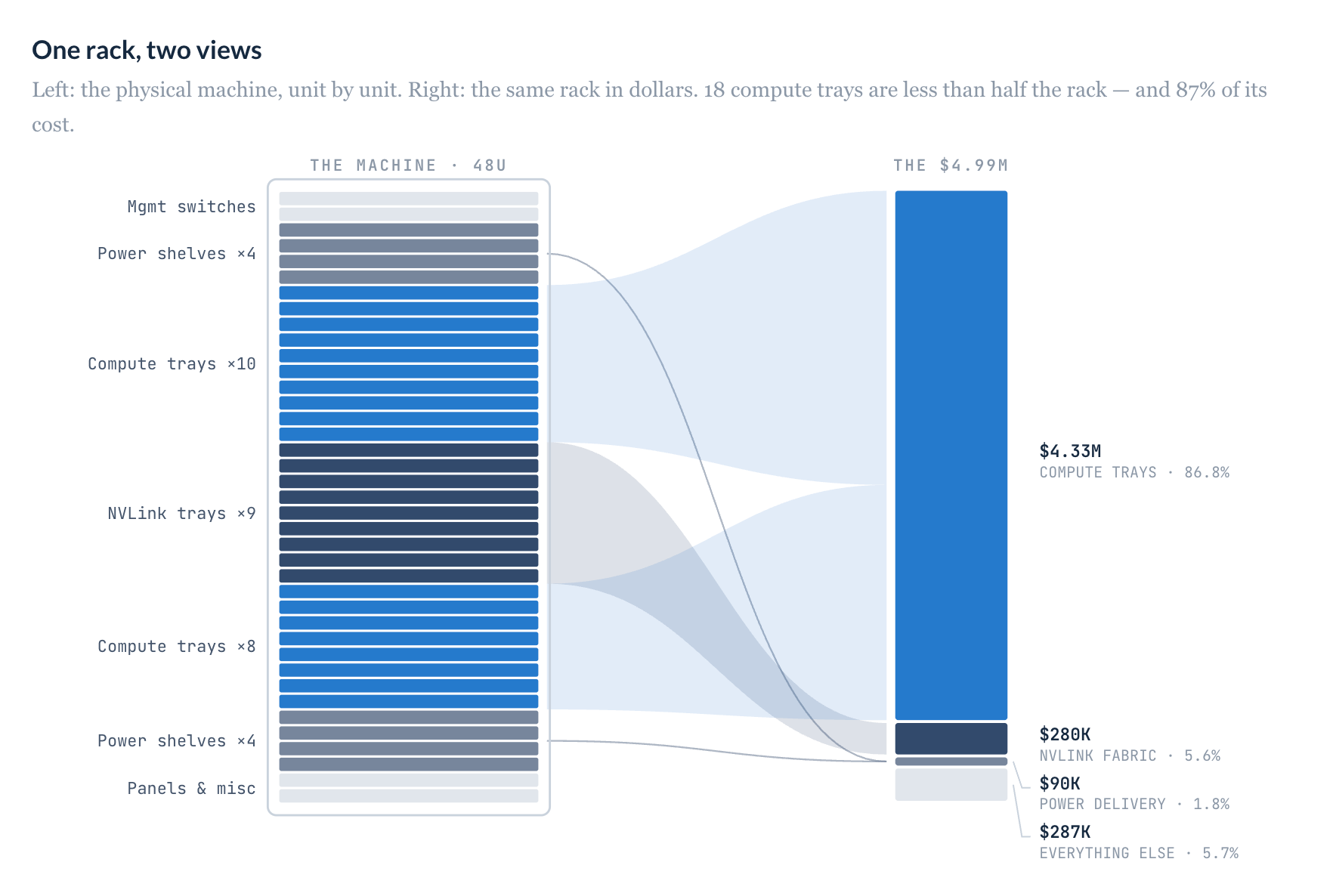
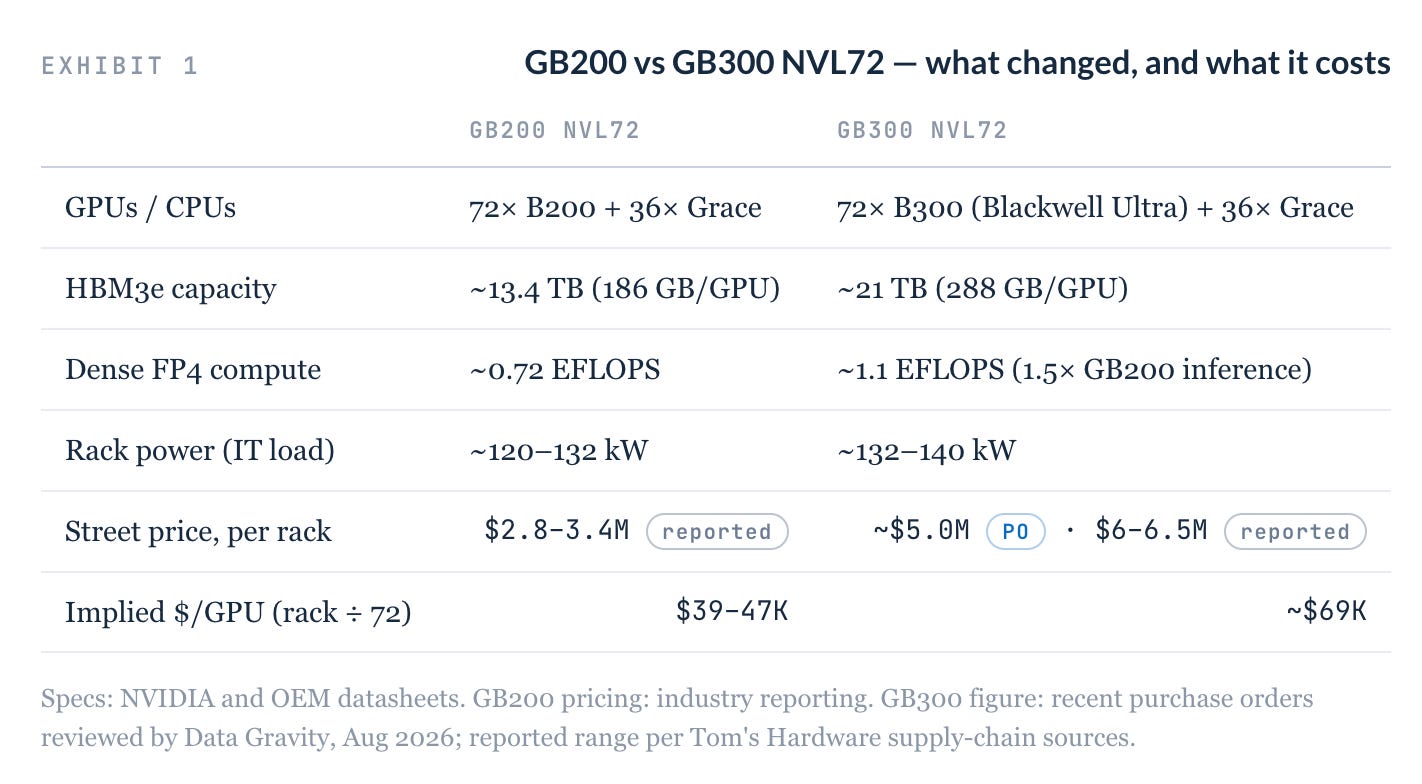
The NVL72 has become one of the basic units of account for Blackwell-scale AI infrastructure — capacity deals, neocloud debt, and NVIDIA revenue models are increasingly denominated in racks. Yet the most-quoted number, “a $3 million rack,” described GB200 and answers the wrong question. The anchor here is a set of recent purchase orders for GB300 NVL72 racks reviewed by Data Gravity in August 2026 (figures adjusted modestly to preserve the buyer’s anonymity), cross-checked against analyst teardowns and public specs.
What you’re buying
A supercomputer sold as one line item: 72 Blackwell Ultra GPUs and 36 Grace CPUs in 18 liquid-cooled compute trays, fused into a single coherent domain by 9 NVLink switch trays — 130 TB/s of aggregate bandwidth. 288 GB of HBM3e per GPU, ~21 TB per rack. It draws 132–140 kW, ten times a conventional enterprise rack, is 100% liquid-cooled, and ships crated at nearly 4,000 lbs.
The rack: about $5 million
Media estimates put GB300 NVL72 at $6–6.5M reported. The best evidence sits lower: recent purchase orders put it at just under $5.0M without an in-rack CDU, and ~$32K more with a 250 kW CDU PO — real transacted numbers for small orders, not list prices. Hyperscale volume buyers will do better. That’s ~$69K per GPU slot, versus ~$40–50K reported for the GPU module alone; the premium is the rest of the machine.
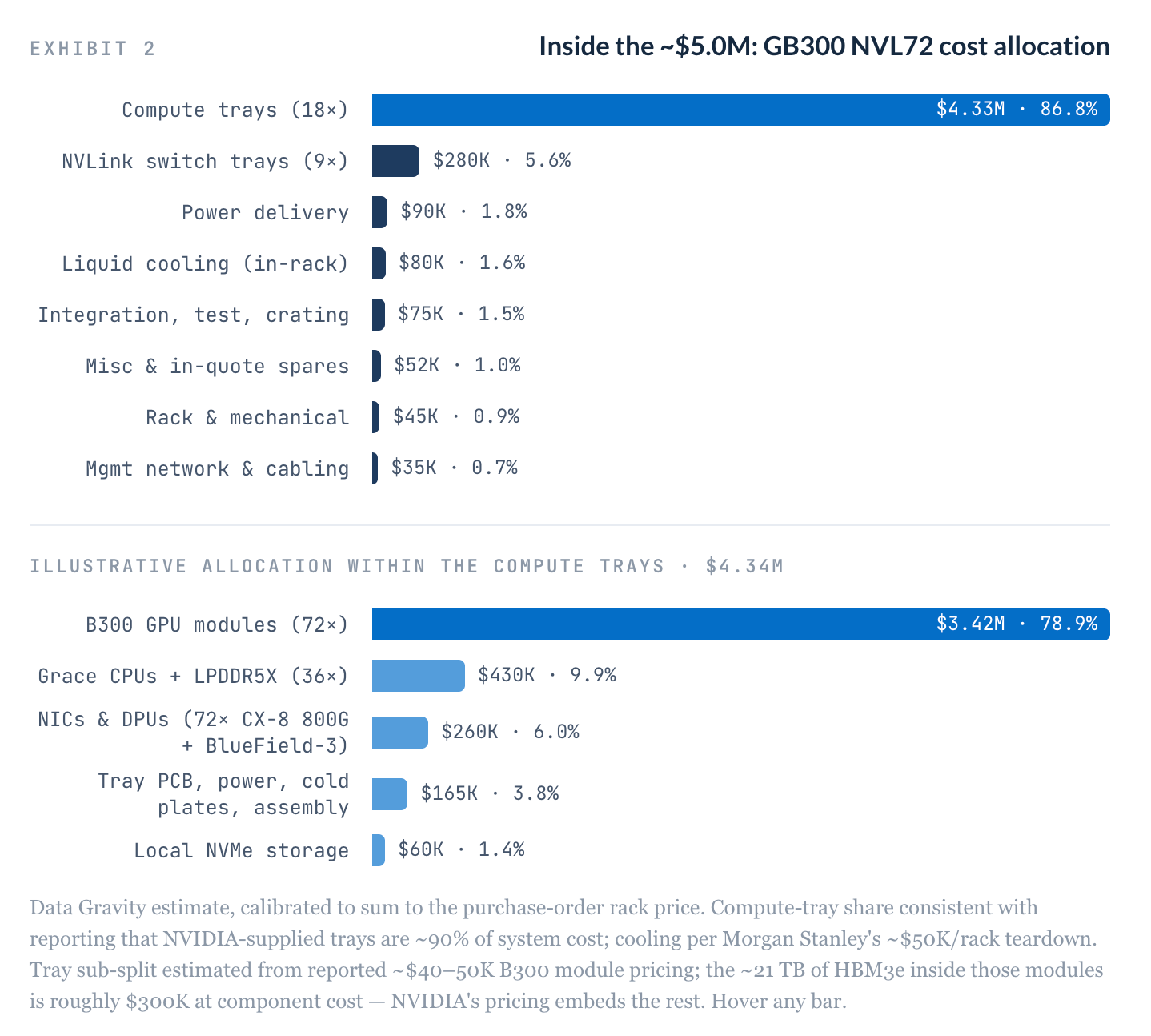
Compute trays are ~87% of the value; split them open and the 72 GPU modules alone are ~$3.4M, with the Grace complex, NICs, and tray hardware making up the rest. With the NVLink fabric included, NVIDIA content exceeds 92%. Everything an infrastructure investor pictures as “the rack” — power shelves, busbar, cold plates, steel, cabling, integration — is under 8%. But it’s the fastest-growing 8%: Morgan Stanley pegs in-rack cooling content up ~20% per generation ($42K on GB200 → $50K on GB300 → ~$56K on Vera Rubin), and rack power keeps climbing toward Rubin-class ~250 kW — a structural tailwind for liquid-cooling, power-electronics, and HBM suppliers even as NVIDIA takes the headline dollars.
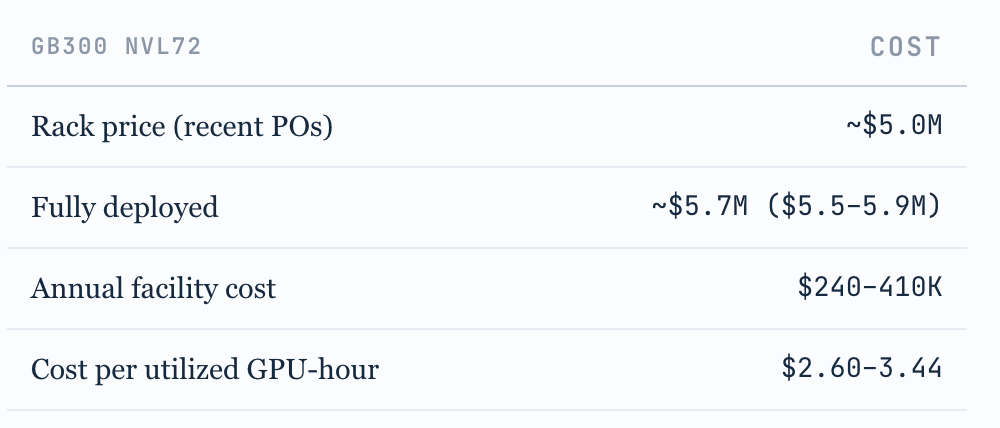
Deployed: closer to $5.7 million
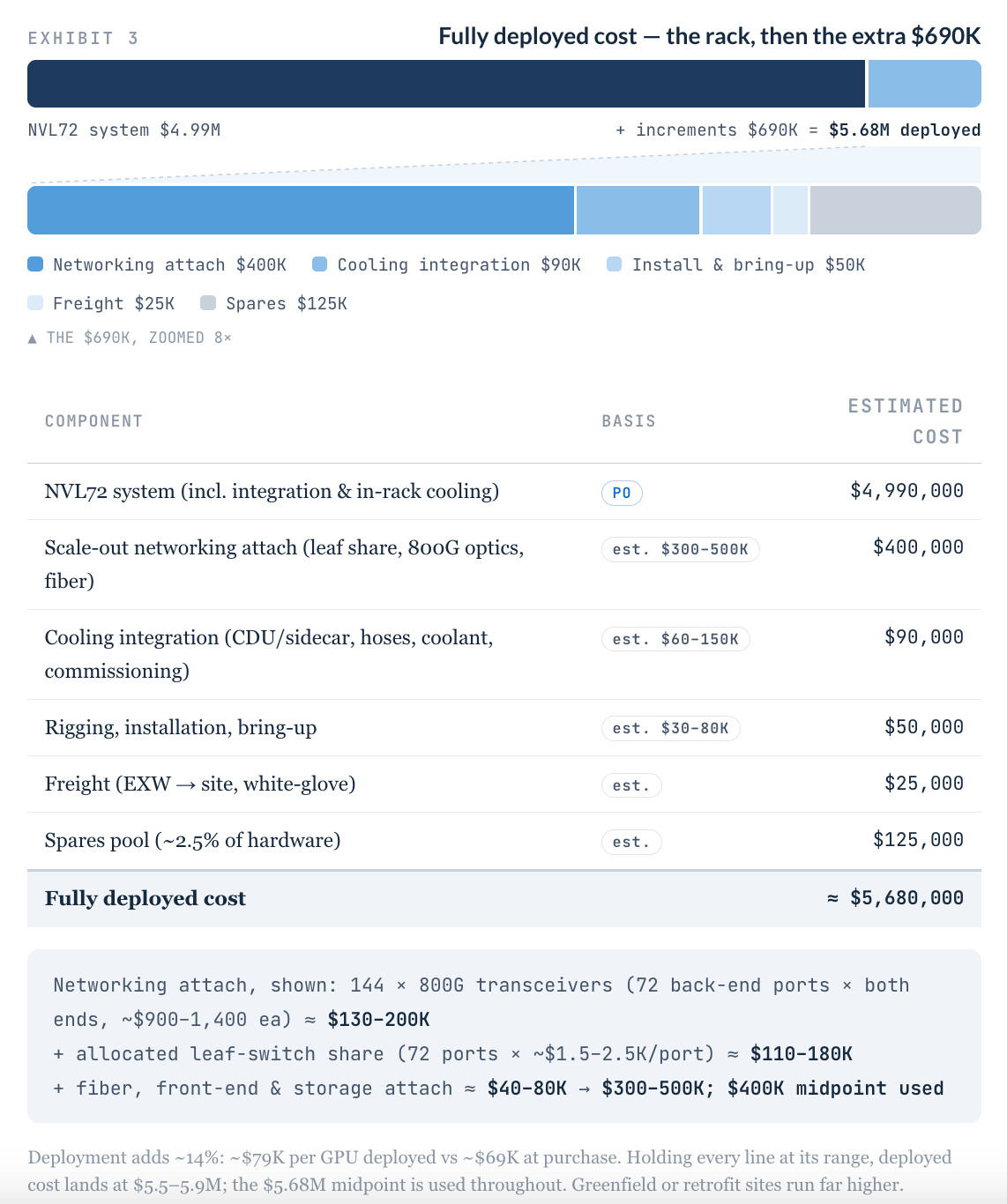
A purchased rack is EXW — your problem from the loading dock. Making it produce tokens in an existing AI-capable facility adds five line items (deliberately excluded: datacenter construction, cluster-level core switching, storage — campus decisions, not per-rack ones):
Operating: $240–410K a year
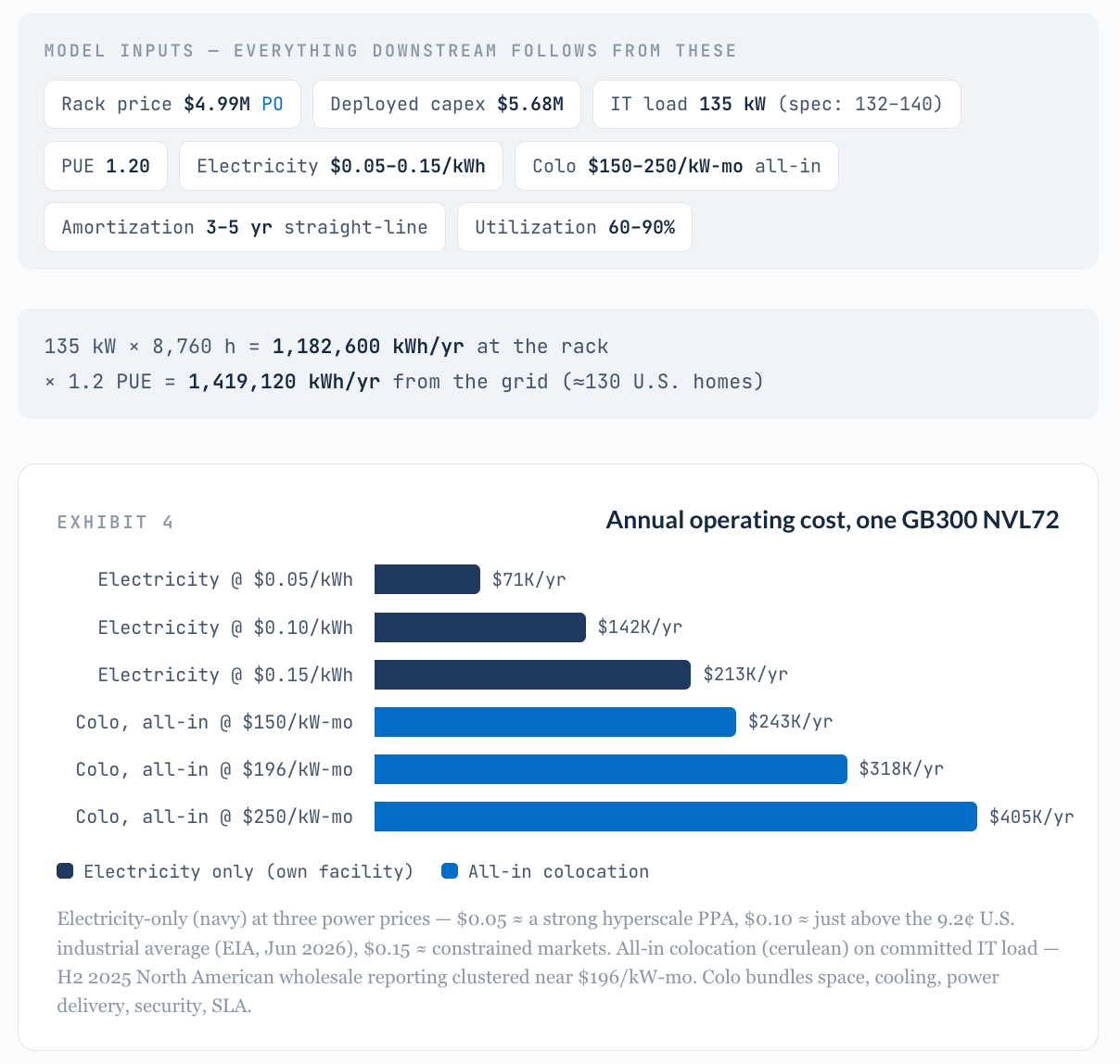
The three price points are anchored, not arbitrary: $0.05/kWh approximates a strong hyperscale PPA in cheap-power markets, $0.10 sits just above the U.S. industrial average of 9.2¢ (EIA, June 2026, up 3% year over year), and $0.15 covers constrained or commercial-rate markets. Power is real money but not the story: even at $0.15/kWh, five years of electricity (~$1.1M) is under a fifth of deployed capex; at colo rates, the five-year facility bill is 18–26% of total cost. The NVL72 is capex-dominated — utilization and depreciation assumptions, far more than power prices, decide whether AI compute is profitable. Facility cost is meaningful but depreciation dominates: roughly $12–34K a month for the facility versus $95–158K a month of straight-line hardware depreciation.
What a GPU-hour needs to cost
One rack holds 72 × 24 × 365 = 630,720 GPU-hours a year; at 60/80/90% utilization you monetize 378K / 505K / 568K of them. We amortize the $5.68M straight-line over 5 years — the center of hyperscaler practice (Microsoft, Google, and Oracle depreciate AI servers over 4–6 years; Amazon runs closer to 4–5; CoreWeave uses 6) and consistent with the rack’s 3-year warranty plus extensions. Add ~$318K/yr of colo:
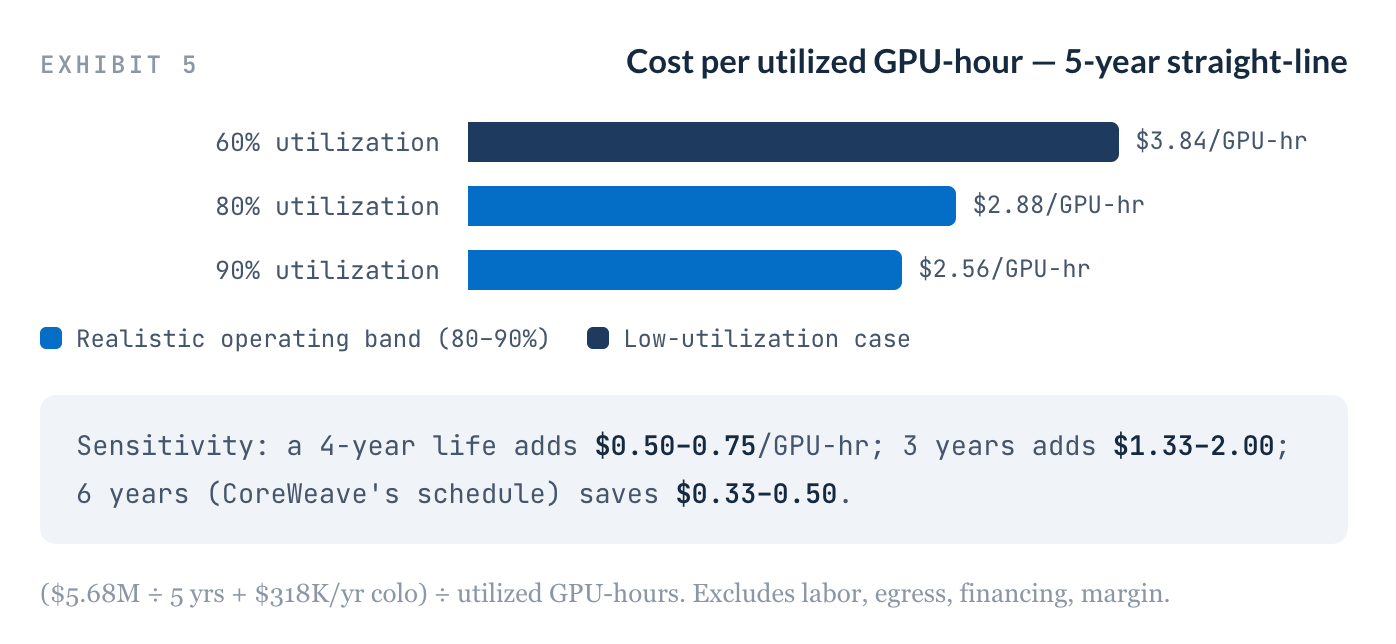
At 80–90% utilization the rack produces compute at $2.56–2.88 per utilized GPU-hour; let utilization slip to 60% and the same rack costs $3.84. Utilization, not the amortization debate, is the bigger lever — and both matter less than the rental price the market will bear (GB200-class capacity has listed around $10.50/GPU-hr, with committed deals well below). One honest caveat on the 5-year life: hardware runs in year 5, but rental rates decay with each GPU generation, so revenue-weighted life is shorter than accounting life.
Why the headline price misleads

A $5 million rack is not a $5 million decision. It’s a multi-year commitment to ~140 kW of liquid-cooled power, several hundred thousand dollars of network attach, and — above all — enough demand to keep 72 GPUs busy before the next generation resets the economics. The purchase price of an NVL72 tells you surprisingly little about the cost of the compute it produces. NVIDIA’s ~$5M of hardware sets the level of those economics; your utilization and useful-life assumptions decide whether they work.
Sources & method
Recent purchase orders for GB300 NVL72 racks (two configurations, with/without in-rack CDU) and accompanying rack BOMs, reviewed by Data Gravity, August 2026. Figures adjusted modestly to preserve the buyer’s anonymity.
Tom’s Hardware / Morgan Stanley — GB300 NVL72 liquid-cooling content ≈$49,860/rack, +20% vs GB200
Supermicro GB300 NVL72 datasheet — 21 TB HBM3e, 132–140 kW, CDU options
NVIDIA GB200 NVL72 specifications · Lenovo GB300 NVL72 product guide
Encor Advisors — North American wholesale colocation ≈$196/kW-month, H2 2025
Yardeni Research — AI server depreciation schedules across hyperscalers (4–6 years; CoreWeave 6)
And to top it all off ... when Nvidia Feynman comes it'll require a completely different in terms of power and cooling and token outputs. Rendering much of this obsoleted.