


In brief
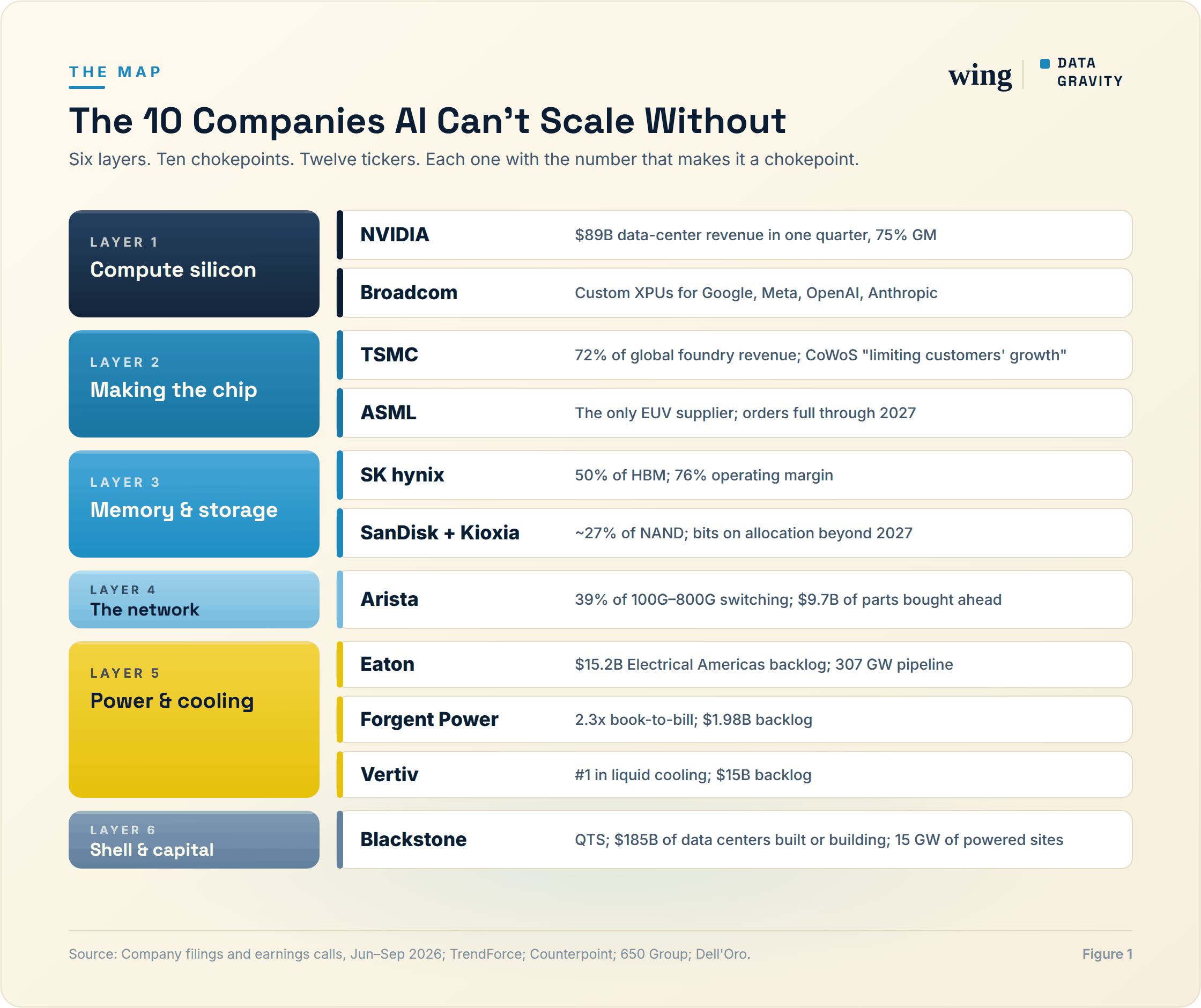
Two kinds of chokepoints: technology monopolies and capacity monopolies. ASML owns the first kind. Blackstone has assembled the largest position in the second. None of the ten can be routed around inside 24 months.
Growth is fastest and margins highest, where the substitute is also sold out. Today that is memory.
NVIDIA’s supply chain guidance shows the value growing in lower layers. The two layers below memory have the longest cure times in the chain and have not been repriced.
The test
I read a short list of earnings calls for the supply chain rather than the company. NVIDIA did great: a $96B quarter, guided to $108B. The question is what stops the next $100B from shipping, and the answer keeps coming from the same handful of names.
One test decides the list. If the company stopped shipping tomorrow, could the hyperscalers route around it within 24 months? For ten steps in the chain the answer is no, for a different reason at each layer. At the top, one company owns the technology. In the middle, the substitute exists but is just as sold out. At the bottom, the whole industry is capacity-limited and the named company is the largest piece of it.
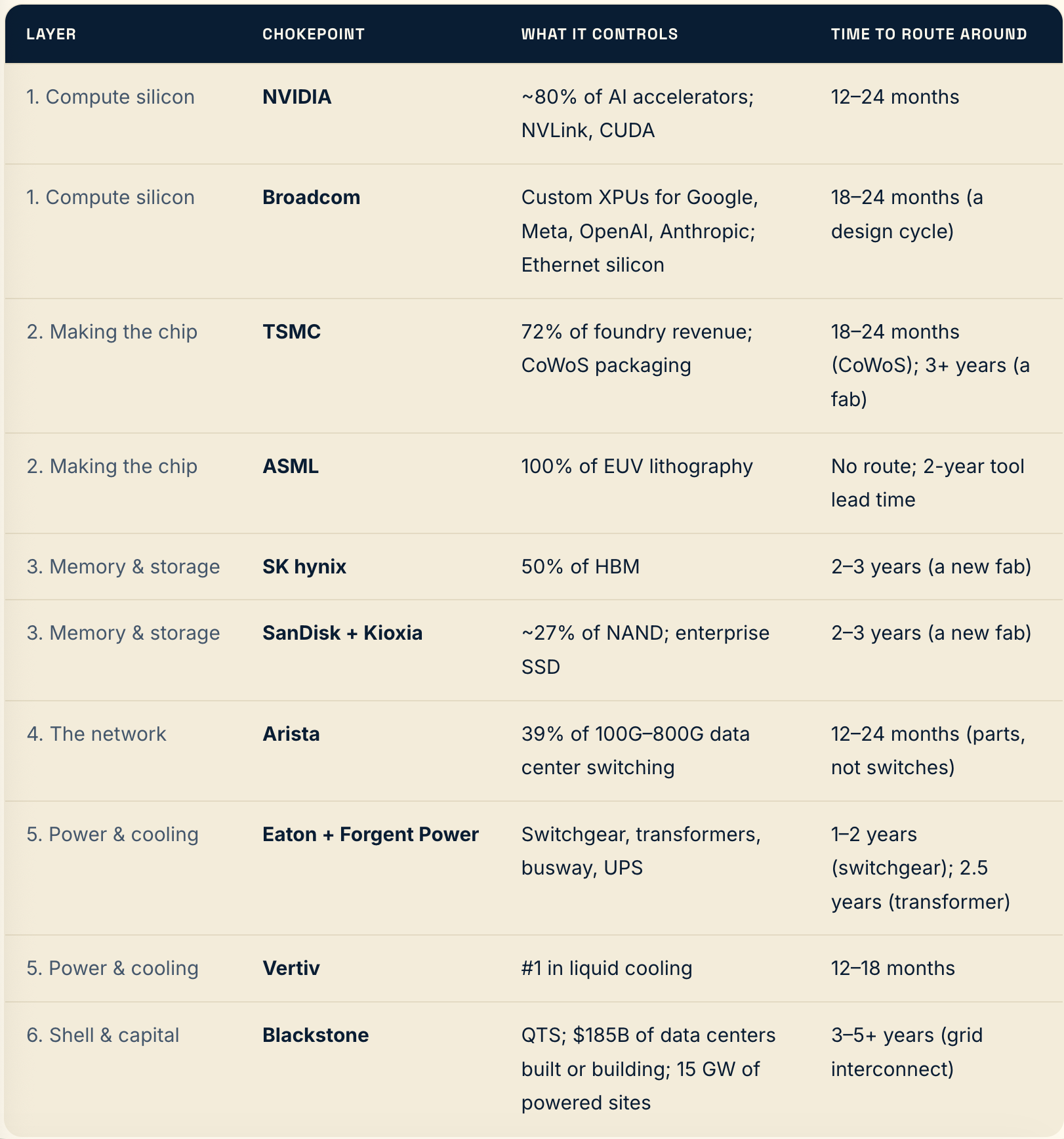
That last case is where a list like this gets attacked, and it is the more interesting half. There are two kinds of chokepoints here. A technology monopoly: one company owns something nobody else can make. ASML is the pure case; NVIDIA and TSMC are close. A capacity monopoly: the input is scarce industry-wide, the queue for more runs years, and one company holds the largest position. Blackstone is the pure case. The input is powered, entitled land with a grid interconnect, the queue is three to five years, and Blackstone holds 15 GW of it. Pick a different landlord and you are still in the same interconnect queue, most of whose near-term slots Blackstone already owns. If you need 500 MW energized in 2028, there is one developer with the sites, the power and the balance sheet to sign for it. Eaton and Forgent are capacity monopolies in switchgear; SanDisk and Kioxia sit between the two kinds. The test does not care which kind you are. What differs is the cure: a technology monopoly ends when someone else learns to make the thing, thirty years and counting for EUV; a capacity monopoly ends when the industry adds capacity, which is what the last column of the table measures.
Ten chokepoints, twelve tickers: SanDisk and Kioxia share one NAND joint venture, Eaton and Forgent sell the same gear at different scale. The laser and transceiver makers are out, not because they are unconstrained (Lumentum is under-shipping its market by 25–30%) but because there are enough of them to move share inside two years.
This is not really a piece about ten companies. It is about where scarcity is going. Three years ago the binding constraint on AI was a chip. Today it is memory. Next are electrical equipment and powered land, which take years, not quarters, to relieve. Scarcity is migrating from silicon toward slower-to-build physical infrastructure, and market capitalization has not migrated with it. The ten are the evidence. The last column of the table is the claim.
Layer 1: Compute silicon. NVIDIA and Broadcom.
NVIDIA is the name every buyer has tried hardest to route around, and none has managed it; the closest route runs through Broadcom, which is why both are here. The quarter was $96.2B, up 106%, at a 75% gross margin, with next year guided to roughly 70% growth and called “supply-constrained.” The largest buyers are buying AMD and designing their own chips. None has replaced NVLink at rack scale or CUDA at software scale, which is why NVIDIA still takes about 80 cents of every accelerator dollar.
Broadcom is the custom route: the XPUs for Google, Meta, OpenAI, ByteDance and Anthropic, and the Tomahawk silicon that connects them. AI semiconductor revenue was $16.7B, up 221%, on a path from about $58B this fiscal year to $115B next and $230B the year after. Marvell is a credible second source, as Amazon’s Trainium shows, but moving a program means redoing the SerDes, packaging and HBM integration, an 18–24 month cycle. Nobody moves a program that is already ramping.
Layer 2: Making the chip. TSMC and ASML.
Everything in Layer 1 is fabbed at TSMC and packaged on its CoWoS. Revenue was $40.2B, up 34% in dollars, at a 67.7% gross margin; HPC is two-thirds of the mix. The nominal substitutes are Samsung at 2nm and Intel at 18A. Samsung has 6.5% of foundry revenue and no volume accelerator on its leading node; TSMC has 72%. The most useful sentence on the call was C.C. Wei on packaging: “our packaging capacity is so tight that now it’s limiting my customers’ growth.” That is not a shortage of his product. It is a ceiling on everyone else’s.
ASML has no substitute of any kind. It is the only maker of an EUV tool, and every leading-edge fab is built around one. Sales were €9.3B, up about 21%, EUV 57% of system sales. Output is about 65 EUV systems this year, 30% more next, and the company already holds “substantially all orders needed for 2027 and a large number of orders for 2028.” This is the slowest clock in the chain: a tool ordered now ships in two years, and the fab it goes into takes longer.
Layer 3: Memory and storage. SK hynix and SanDisk-Kioxia.
Here the substitute exists and is equally sold out, which is the structure that produces the most violent pricing in the chain.
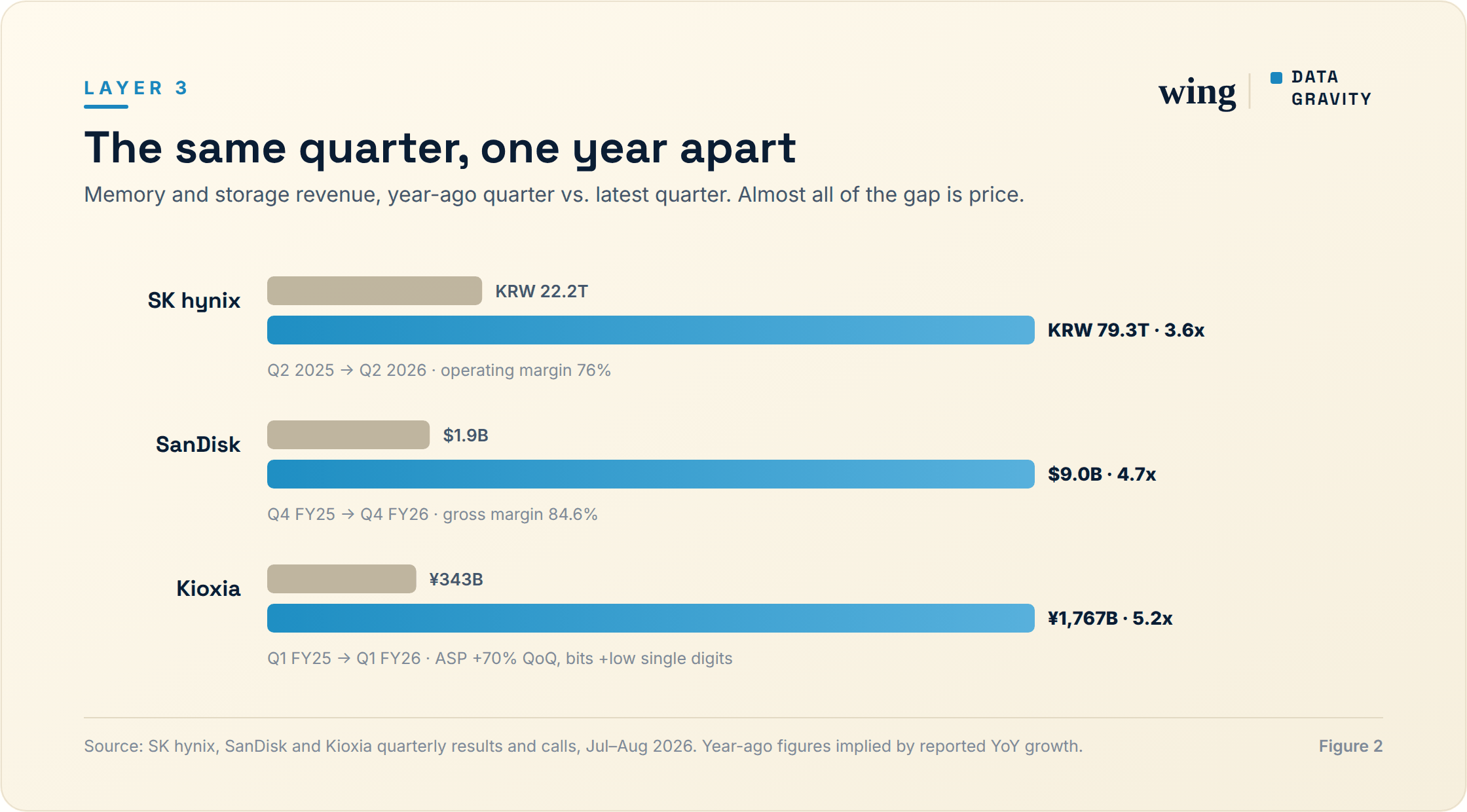
SK hynix holds half the HBM market and has HBM4 in mass production. Revenue for the quarter ended June 30 was KRW 79.3T, up 257%, with operating profit of KRW 60.5T: a 76% operating margin, after R&D and SG&A, higher than NVIDIA’s 75% gross margin for the quarter ended July 26, before either. I checked the arithmetic twice. Samsung and Micron are the alternatives; Micron says its HBM is sold out for the year, and SK hynix’s CEO told Reuters in July that 2027 will be “the worst year in the industry’s history from the supply perspective,” with demand above supply “even beyond 2030.” Memory executives are trained by experience to expect the opposite.
SanDisk and Kioxia run a NAND joint venture producing roughly 27% of the world’s bits, including the enterprise SSDs inference fleets read from. SanDisk’s fiscal fourth quarter, the thirteen weeks to July 3, was $8.97B, up 372%, at an 84.6% gross margin, GAAP and non-GAAP alike. Bits are “on allocation beyond CY2027,” and two-thirds of the following year’s supply is contracted under a $93.9B floor-price minimum. Kioxia’s revenue rose 416% on ASPs up about 70% quarter over quarter while bit shipments grew low single digits; its non-GAAP gross margin was 80%. Memory has stopped being a commodity cycle and become a take-or-pay business, at least until the new fabs arrive.
Layer 4: The network. Arista.
On paper Arista is the easiest name here to route around: Cisco, Spectrum-X and white boxes all exist. In practice the constraint moved from the switch to the parts inside it, and Arista bought the parts first. Purchase commitments for memory, silicon, PCBs and optics reached $9.7B against a $3.04B quarter, up 38%; full-year guidance is $12.6B; it holds 39% of 100G–800G data center switching to Cisco’s 18%. Jayshree Ullal: “The industry is going to have a 2-year problem. I don’t think we get out of it as an industry until 2028.” Arista has already paid for the two years.
Layer 5: Power and cooling. Eaton, Forgent and Vertiv.
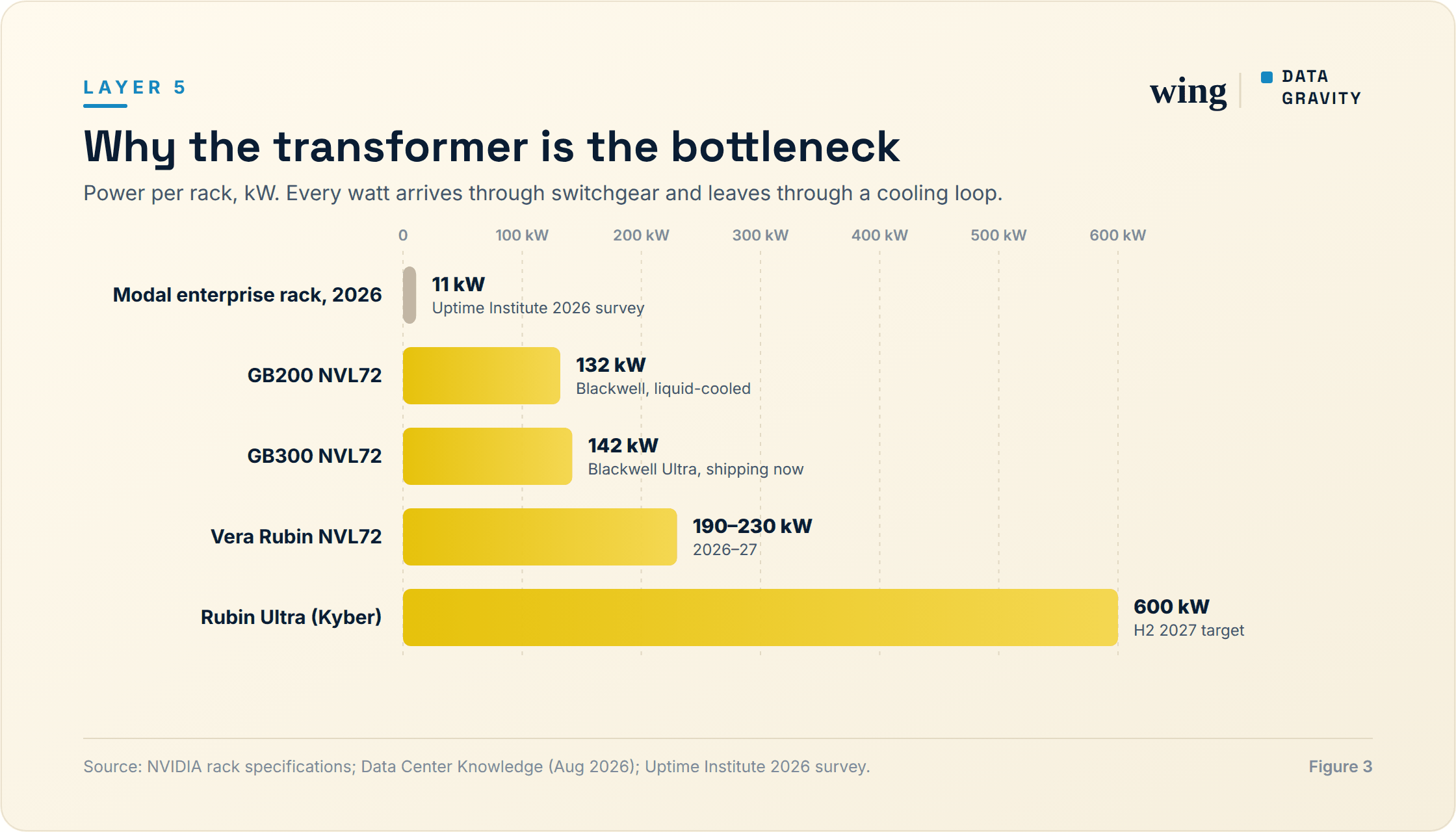
A GB300 NVL72 rack draws up to 142 kW; Vera Rubin NVL72 will draw 190–230; the modal enterprise rack in Uptime’s 2026 survey draws 11. Every watt arrives through switchgear and leaves through a cooling loop, and this is the layer where the constraint belongs to the industry: 52–104 weeks for medium-voltage switchgear, 128 weeks for a power transformer, and no vendor quotes materially better.
Eaton is the incumbent. Sales were $8.5B, up 14% organic; data center orders up about 85%; Electrical Americas backlog $15.2B, roughly a year of that segment’s sales, up from about ten months a year ago, with orders still outrunning revenue (up 41% against 18%). The number to underline is 307 GW, Eaton’s count of the U.S. data center pipeline, most of it delivering in 2028 and beyond. A new Nebraska switchgear plant comes online in 2027.
Forgent Power is the smallest name here and the purest read on the shortage: custom switchgear, transformers, eHouses and PDUs, assembled from four regional manufacturers, listed in February in a $1.5B IPO. Revenue was $379M, up 103%; bookings $867M, up 308%, a 2.3x book-to-bill; backlog $1.98B, up 157%. Forgent added $490M of backlog in a quarter it shipped $379M. The backlog covers five quarters at run-rate, 17 months of the full-year guide, against about twelve at Eaton. A backlog growing faster than shipments while shipments double is what an unrelieved constraint looks like in a filing. Its pitch is speed: custom gear “in as little as a week” in a market quoting a year or two.
Vertiv leads liquid cooling, a $3B market last year heading to $7B by 2029, and sells the power train with it. Sales were $3.27B, up 18% organic; full-year guidance $14.0B at the midpoint, up 31% organic; backlog $15.0B at year end, about 1.1x revenue. Customers are asking for “12 to 18 month delivery windows.” The cooling loop is now ordered on the transformer’s schedule.
Layer 6: The shell and the money. Blackstone.
Every layer above ends up in a building that has to be financed. Blackstone owns both problems. Through QTS, bought for about $10B in 2021, it runs what Steve Schwarzman calls “the largest data center development business in the world”: $185B of data centers built or under construction at the end of June, up from $130B in January and $70B two years ago, with $160B of prospective pipeline behind it. Jon Gray’s number is the one that matters here: 15 gigawatts of sites with entitlements and power already in hand, enough for about $200B of data centers. QTS announced two $10B campuses this summer alone.
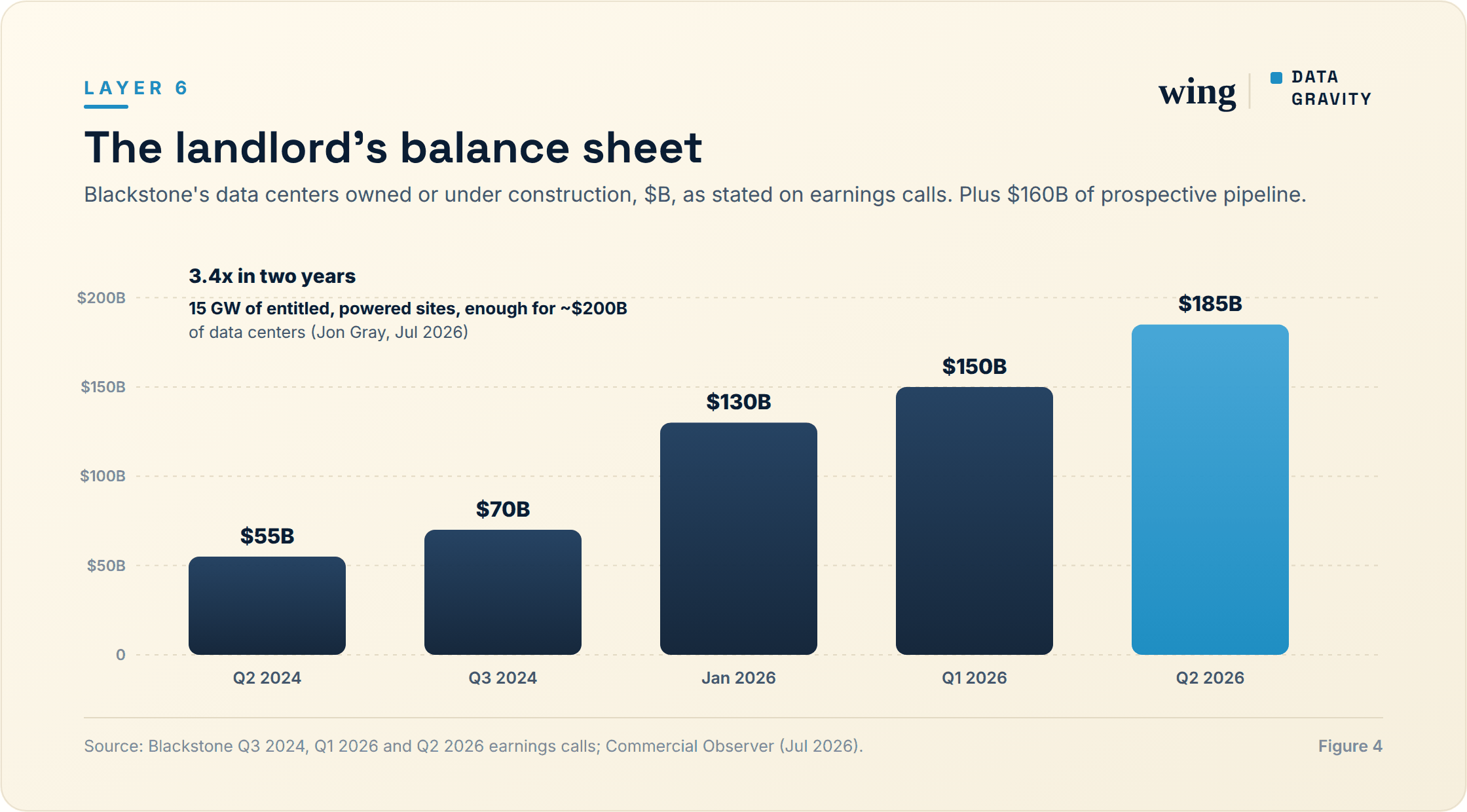
The credit side is the same bet from the other direction: close to $10B lent to CoreWeave across two facilities, the anchor in the $35B first tranche of the Broadcom and Apollo platform aimed at 20 GW, and roughly $15B of QTS bonds and loans since November. Blackstone does not break ground without a 15-year lease, which is why the data center book has been the largest single driver of returns in both its infrastructure and real estate funds. Plenty of capital wants this trade. None of it has 15 GW of entitled, powered sites, the developer to convert them, and the credit arm to finance the tenant. That combination is not a fundraise. It is a decade of land, interconnect queues and utility relationships.
The pattern
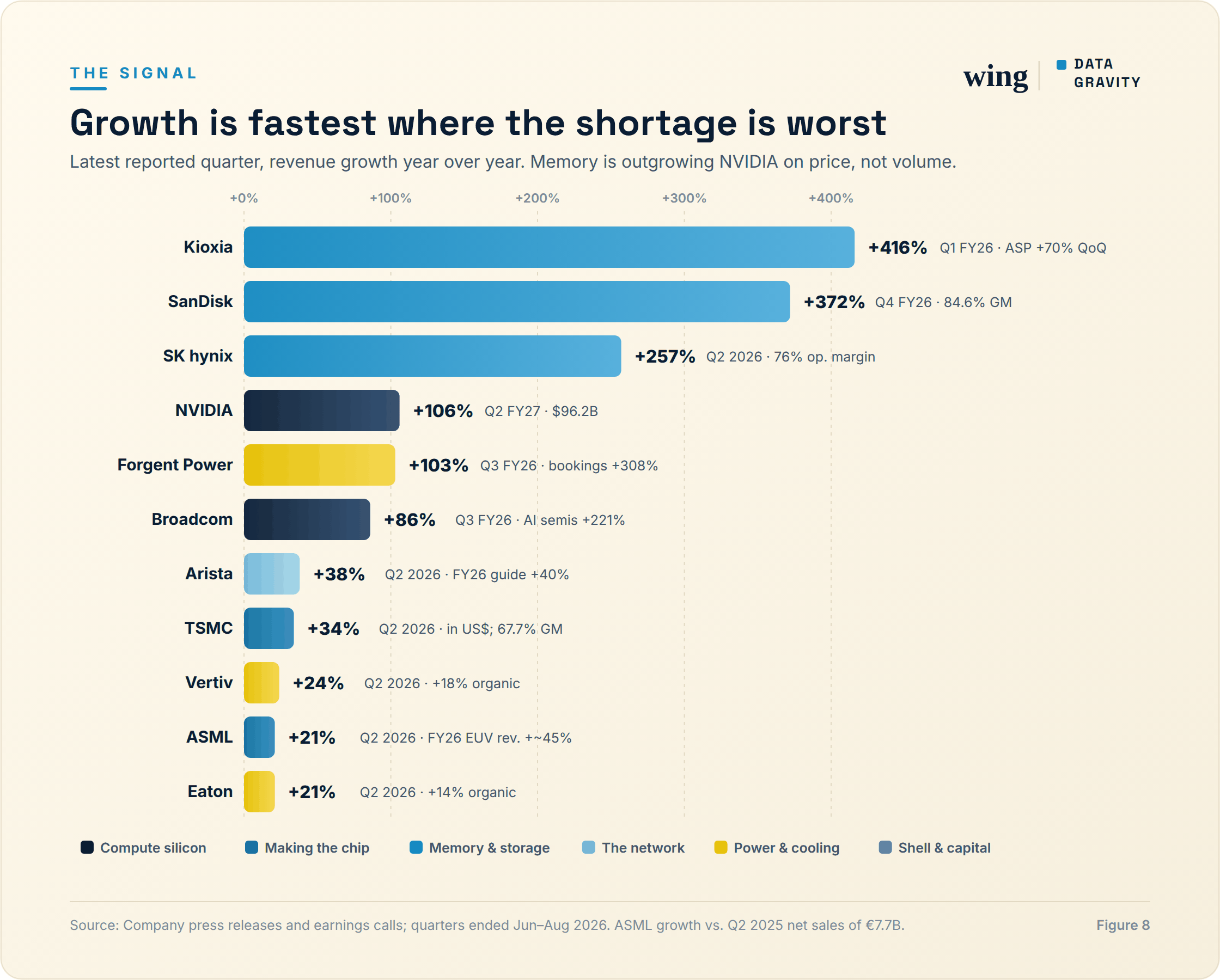
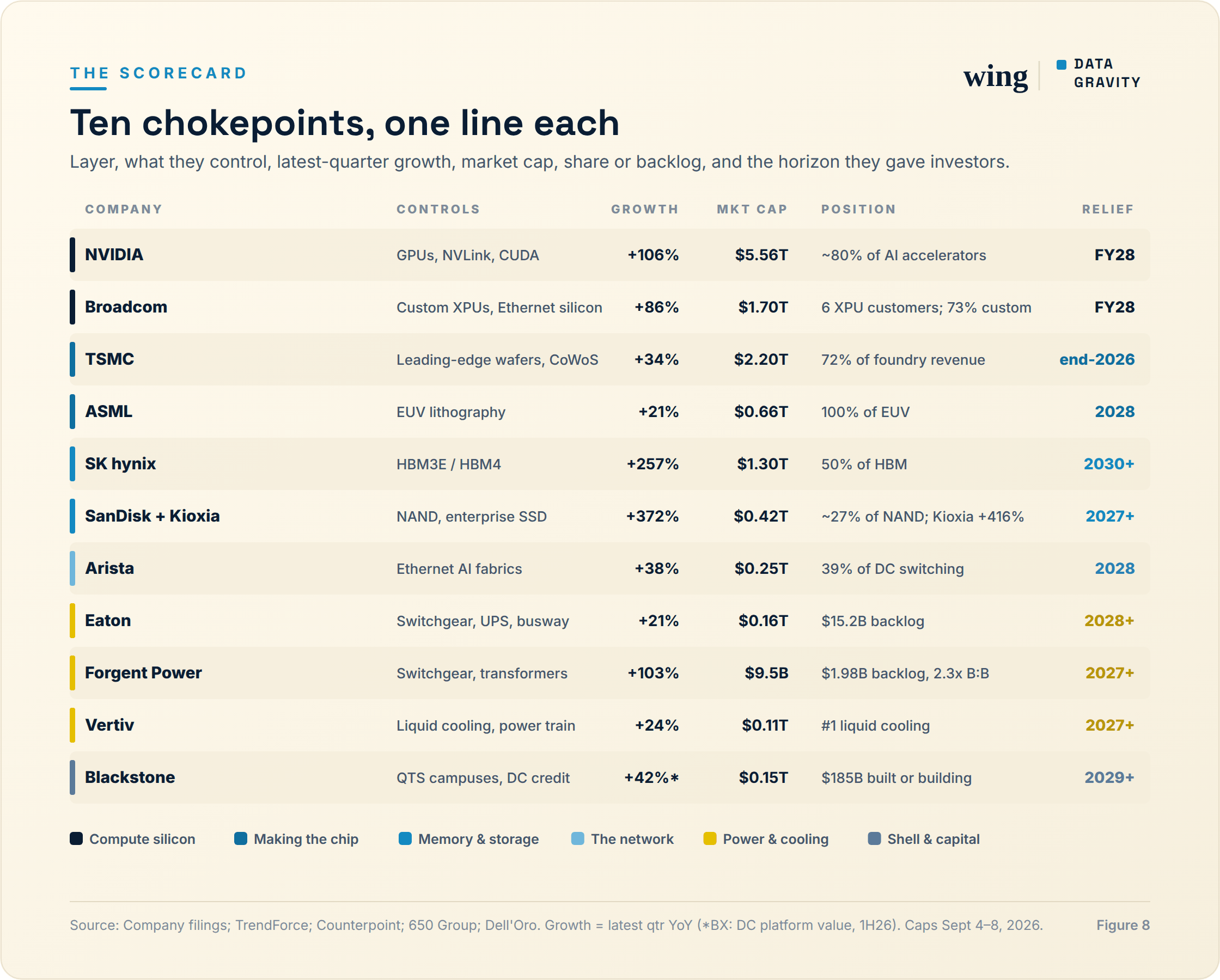
Three things fall out of the numbers side by side. Growth is fastest where the substitute is also sold out: memory and storage grew 257%, 372% and 416%, faster than NVIDIA, and nearly all of it is price. SanDisk said two-thirds of its sequential growth was pricing; Kioxia's bits grew low single digits while revenue quintupled.
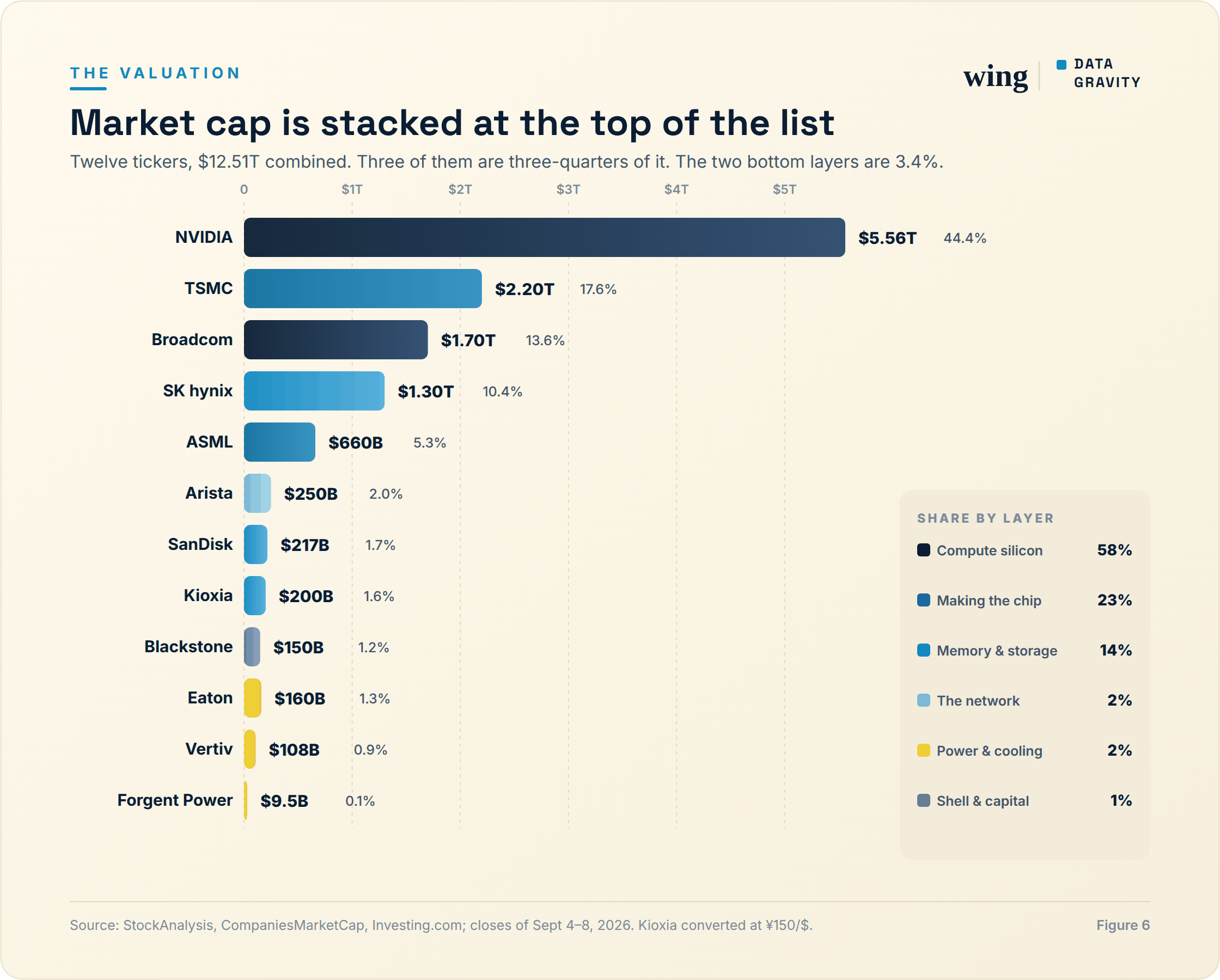
Market cap is stacked at the top of the list and lead times at the bottom. The twelve are worth about $12.5T; NVIDIA, TSMC and Broadcom are three-quarters of it. Power equipment and the landlord are about $430B, 3.4%, on the longest lead times in the chain.
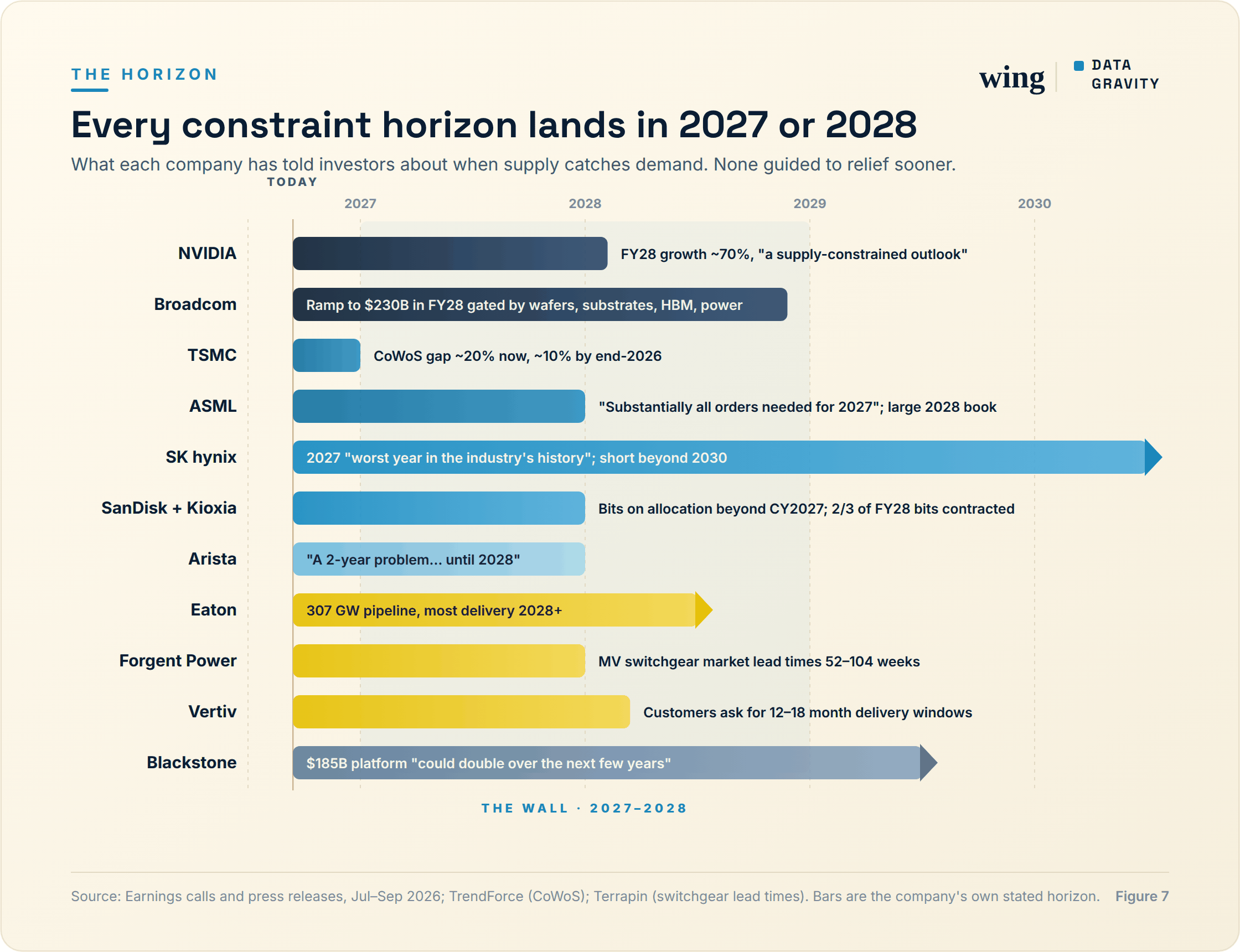
And every stated horizon lands in 2027 or 2028. ASML is booked through 2027. SK hynix calls 2027 the worst supply year on record. SanDisk is on allocation beyond 2027. Arista says 2028. Eaton’s pipeline delivers in 2028 and beyond. Blackstone’s platform “could double over the next few years.” Not one of the ten guided to relief sooner.
Who takes the money
NVIDIA’s own guidance is the cleanest evidence of where margin is flowing. Gross margin falls from 75% to 71–72% by the fourth quarter because DRAM prices “exceeded our prior expectations and are headed even higher.” Three to four points of the most profitable large company in the world are moving down one layer, to SK hynix. That is what a binding constraint looks like in a P&L: the layer below takes margin from the layer above, without asking.
Write the chain out. GPU scarcity in 2023 produced GPU margins: NVIDIA went from a high-50s gross margin to 75%. HBM scarcity in 2026 produced HBM margins: SK hynix went from a cyclical memory business to a 76% operating margin and took three points from NVIDIA on the way. The next two links are electrical scarcity and powered-land scarcity, and the margins beside them are still blank: Eaton 23%, Vertiv 22.6%, Forgent 22.4% EBITDA, Blackstone’s returns booked as fund appreciation rather than as a rent anyone has priced. If scarcity rent migrated into memory economics, why would some of it not migrate into electrical equipment and power?
The market’s answer, read off the multiples, is odd. It has given memory the earnings but not the multiple: SK hynix trades at about 8x trailing and under 6x forward, the market paying for this year and not believing in 2028. It has given power the multiple but not the earnings: Vertiv 39x forward, Eaton 31x, on margins in the low twenties. Neither is the pricing of a constraint that lasts; memory still carries a cycle multiple, power still carries an industrial margin. The three power and cooling names are worth a fifth of Broadcom. Blackstone, with more data center capacity than anyone, is worth 3% of NVIDIA. I do not know whether those gaps close. I know the earnings half closed for memory inside eighteen months, and that a new fab arrives faster than a new grid interconnect.
That is the claim in one sentence: the opportunity is migrating down the stack faster than the market capitalization is.
The chokepoint index
Four questions, each scorable. How severe is the constraint? How long is the cure? How much scarcity rent is the company earning today? How much has the market already priced? The first three add up to how much of a chokepoint a company is; the fourth is how much of that is in the stock. The gap is the interesting number.
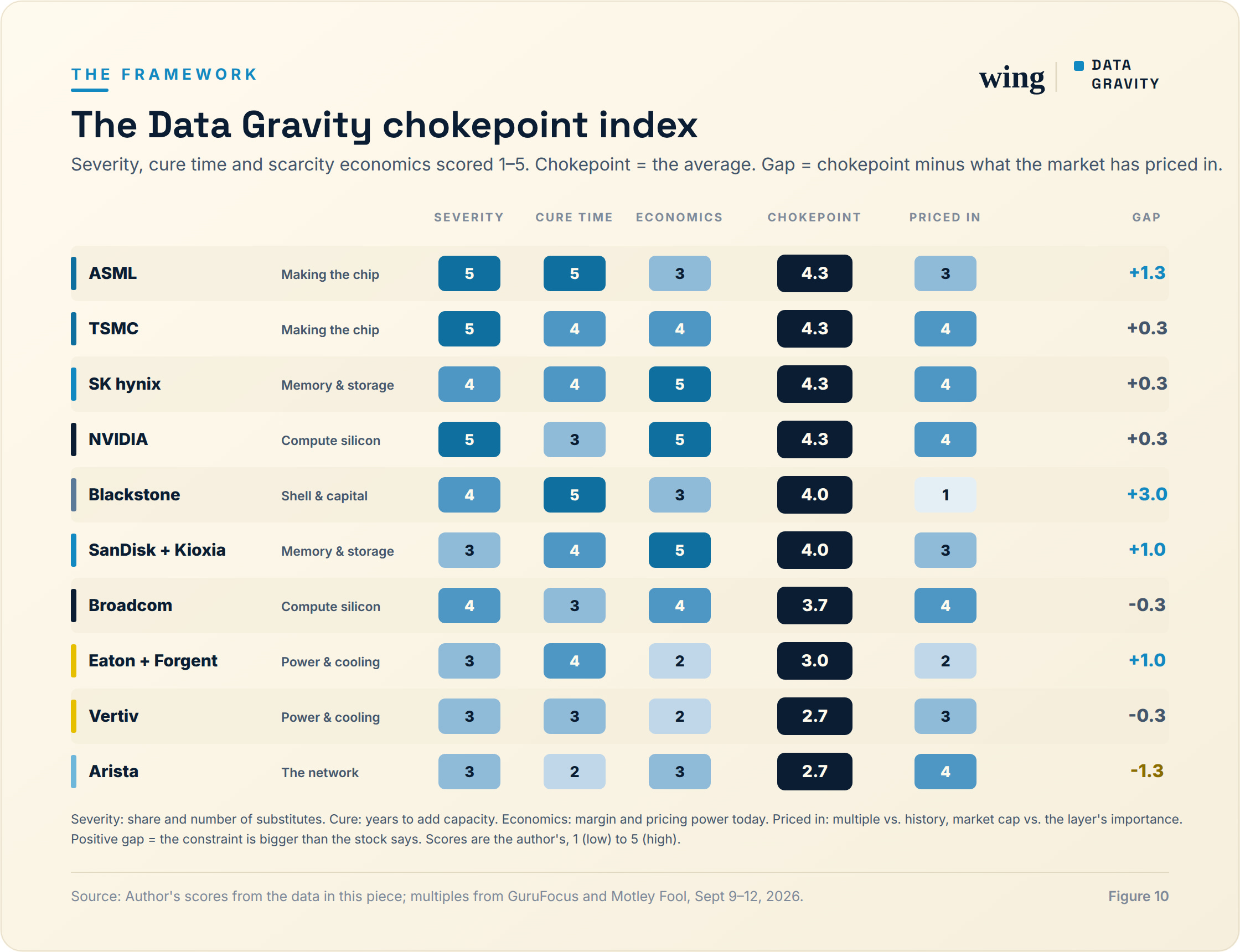
The scores are mine and coarse, but the ranking is not sensitive to a point either way. ASML and Blackstone lead because long cure times meet a market that has not paid for the constraint: ASML trades like cyclical capital equipment, Blackstone’s platform is one line inside a $1.35T asset manager. Eaton and Forgent follow for the same reason. NVIDIA and Broadcom land near zero: severe constraints the market has priced about right, which with a 70% growth guide is not the same as expensive. Arista sits at the bottom as a fully priced one. Memory sits in the middle: severe constraint, extraordinary economics, and a forward multiple that already assumes the cycle ends. I do not, at least not before the fabs arrive.
Where the constraint goes next
Constraints migrate toward whatever takes longest to build. In 2023 it was GPU allocation, and H100 lead times fell from a year to a few months once wafer starts caught up. In 2024 and 2025 it was CoWoS, which TSMC roughly doubled each year. In 2026 it is HBM, and a DRAM fab is a two-to-three-year build. Next is electrical equipment, where a switchgear plant announced in April produces in 2027 and a transformer ordered today arrives in 2029. Behind that is the powered site itself, which is why the landlord is on the list at all.
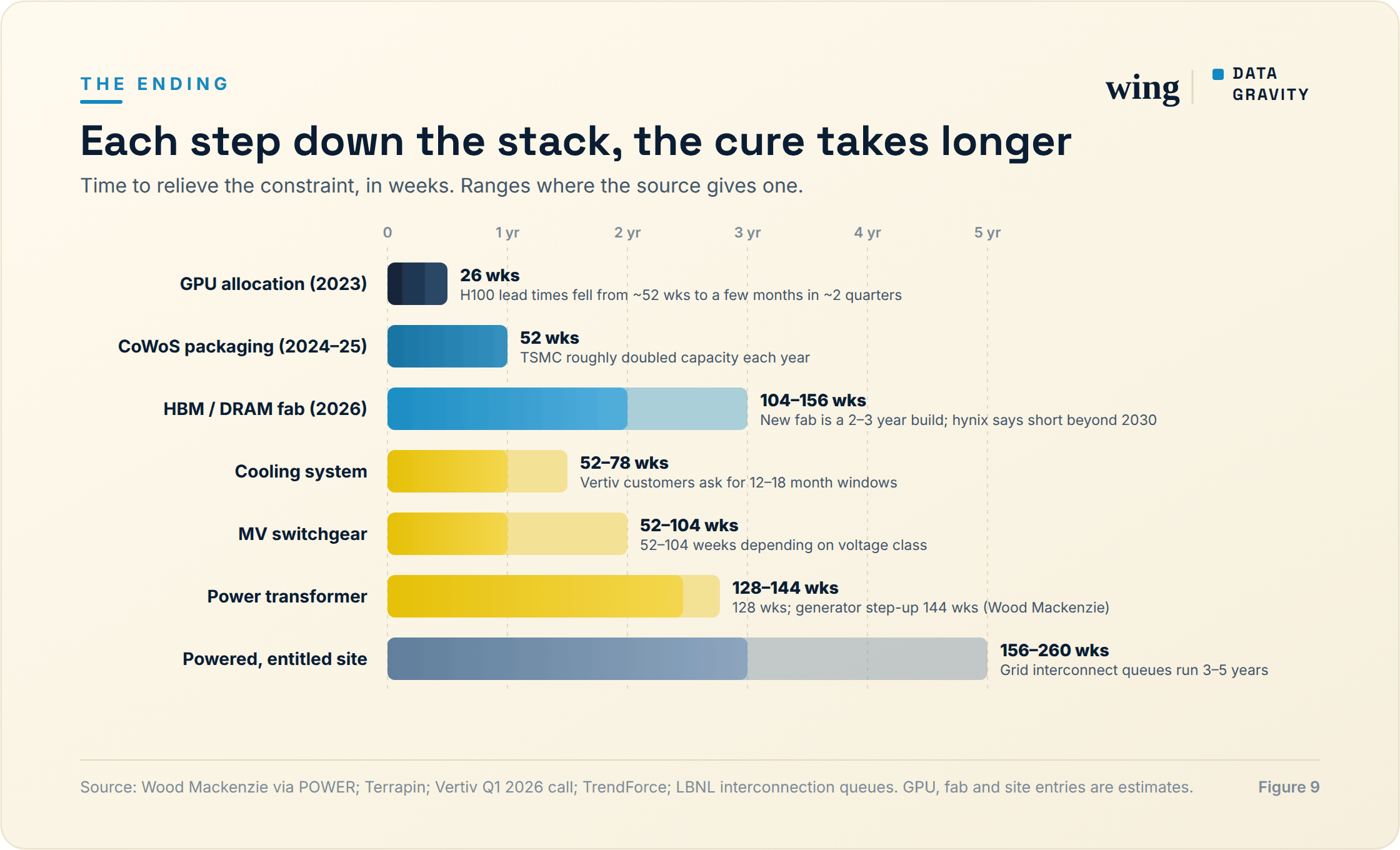
Each step down, the cure takes longer. That is why I expect this list to look the same in 2028: what makes each of these companies impossible to route around is what makes it slow to copy.
Stated the way I would state it to an LP: the obvious AI trade in 2023 was compute, and it paid. The obvious constraint in 2026 is memory, and the earnings have arrived even if the multiple has not. The less obvious trade is the bottlenecks whose earnings have not yet caught up to their scarcity: electrical equipment, cooling, and the powered land underneath them. The cure times say those earnings are coming. The multiples say the market wants proof. That gap is the piece.
What would make me wrong
Four things, in the order I worry about them. First, and the one that matters for the thesis rather than the list: the supply response in electrical equipment arrives faster than the lead times suggest. Eaton’s Nebraska plant produces in 2027. Forgent says its footprint can support $5B of annual revenue, 3.6x this year’s guide, and a company that can triple output is not one whose customers pay a scarcity rent for long. Switchgear is easier to add than EUV tools. The transformer and the interconnect are where I am confident the cure is slow; the rest of the electrical layer I hold more loosely.
Second, hyperscaler capex breaks in 2027 and backlogs become cancellations. Everyone funding this chain is still guiding up, but that is one budget cycle away, and Blackstone’s insistence on 15-year leases is how the smartest landlord in the business prices that risk. Third, Samsung qualifies HBM4 at volume and Micron scales, and the duopoly goes back to the three-way price war it has been for thirty years; the sub-6x forward multiple says the market expects exactly this. Fourth, the power constraint is solved by relocation rather than equipment, with capacity moving to wherever interconnects already exist, which is the bet Blackstone’s 15 GW is implicitly making.