


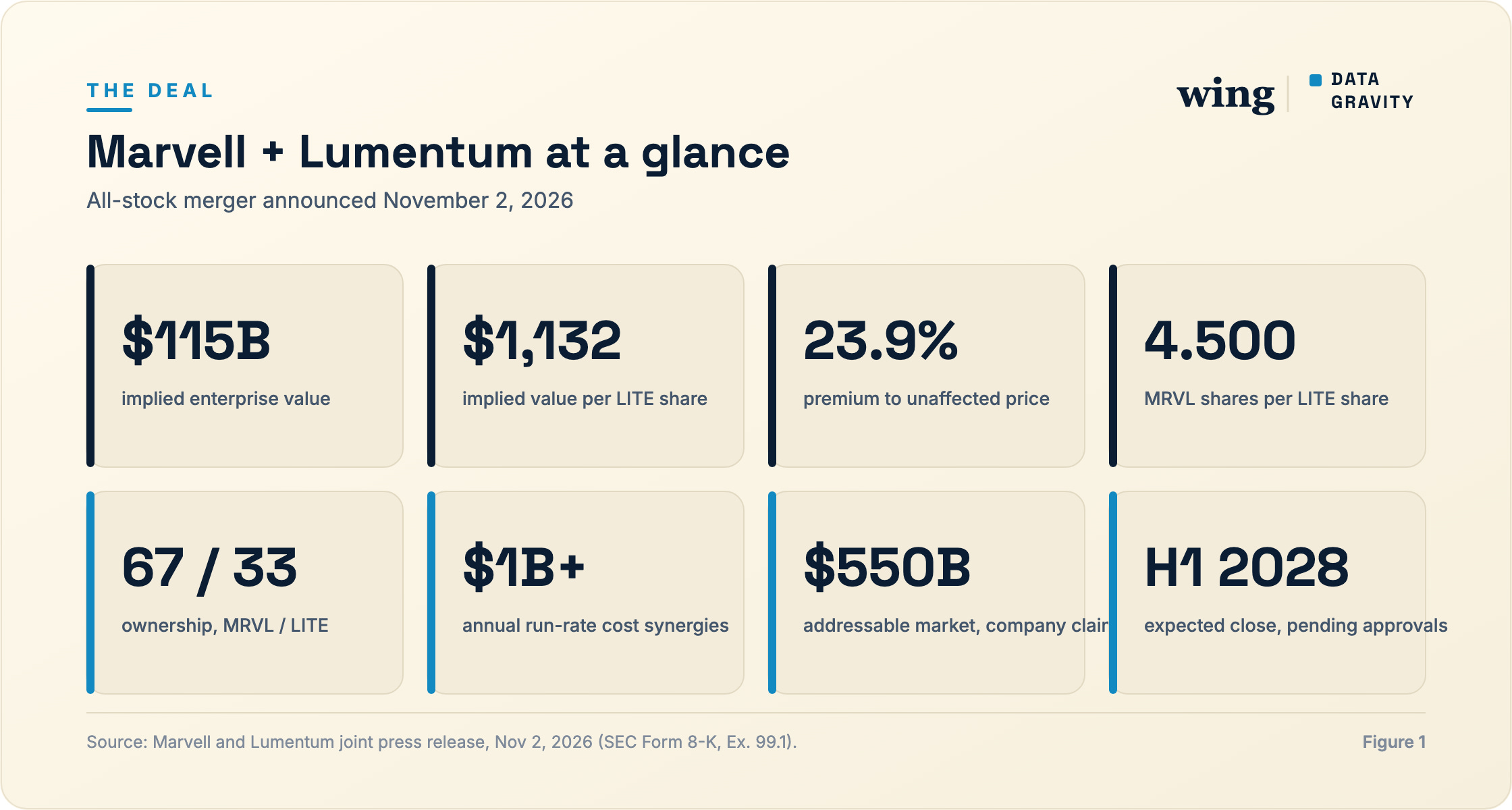
The deal. Marvell is buying Lumentum in an all-stock deal valued at about $115B, or $1,132 per share. That’s a 23.9% premium. Lumentum shareholders will own 33% of the combined company. Closing is expected in the first half of 2028.
The reason. Co-packaged optics (CPO) threatens Marvell’s most profitable optical product, the DSP. Lumentum’s lasers are needed with or without CPO, and they are sold out into 2029.
The combined company. Roughly $19B of annual revenue and $7.6B of operating income at today’s run rate, about a 40% margin. If Marvell hits its $1B cost-savings target, that rises to about 45%.
The price. About 18x Lumentum’s run-rate revenue. That’s expensive, but Lumentum shareholders get 33% of the company while bringing about 38% of its operating profit.
Marvell announced the deal on Monday morning. It’s more than ten times larger than any acquisition the company has done before.
The easiest way to understand it is to look at what’s happening inside AI data centers. The chips are fast enough. The bottleneck now is moving data between them. At these speeds copper runs out of reach after a meter or two, so more and more of the network is moving to light.
Marvell has done very well from that shift so far. The problem is where the shift goes next.
1. Why Marvell wants a laser company
Most optical links in AI clusters today use pluggable transceivers. These are small modules that slot into the front of a switch or server. Each one has three key parts:
A DSP, which cleans up the electrical signal after it crosses the circuit board. Marvell is the leading supplier.
A driver, which handles the analog signal.
A laser, which turns the signal into light. Lumentum is one of the main suppliers.
Co-packaged optics moves the optical parts onto the same package as the switch or accelerator chip. The signal no longer travels across a board, so there is much less to clean up. In most CPO designs the DSP goes away. Counterpoint Research says CPO “mostly eliminates the need” for Marvell’s DSPs.
The laser stays. It usually moves outside the package as a separate light source, but it still has to be made, and it is made in indium phosphide (InP) fabs that take years to build. Lumentum and Coherent own most of the world’s InP capacity.
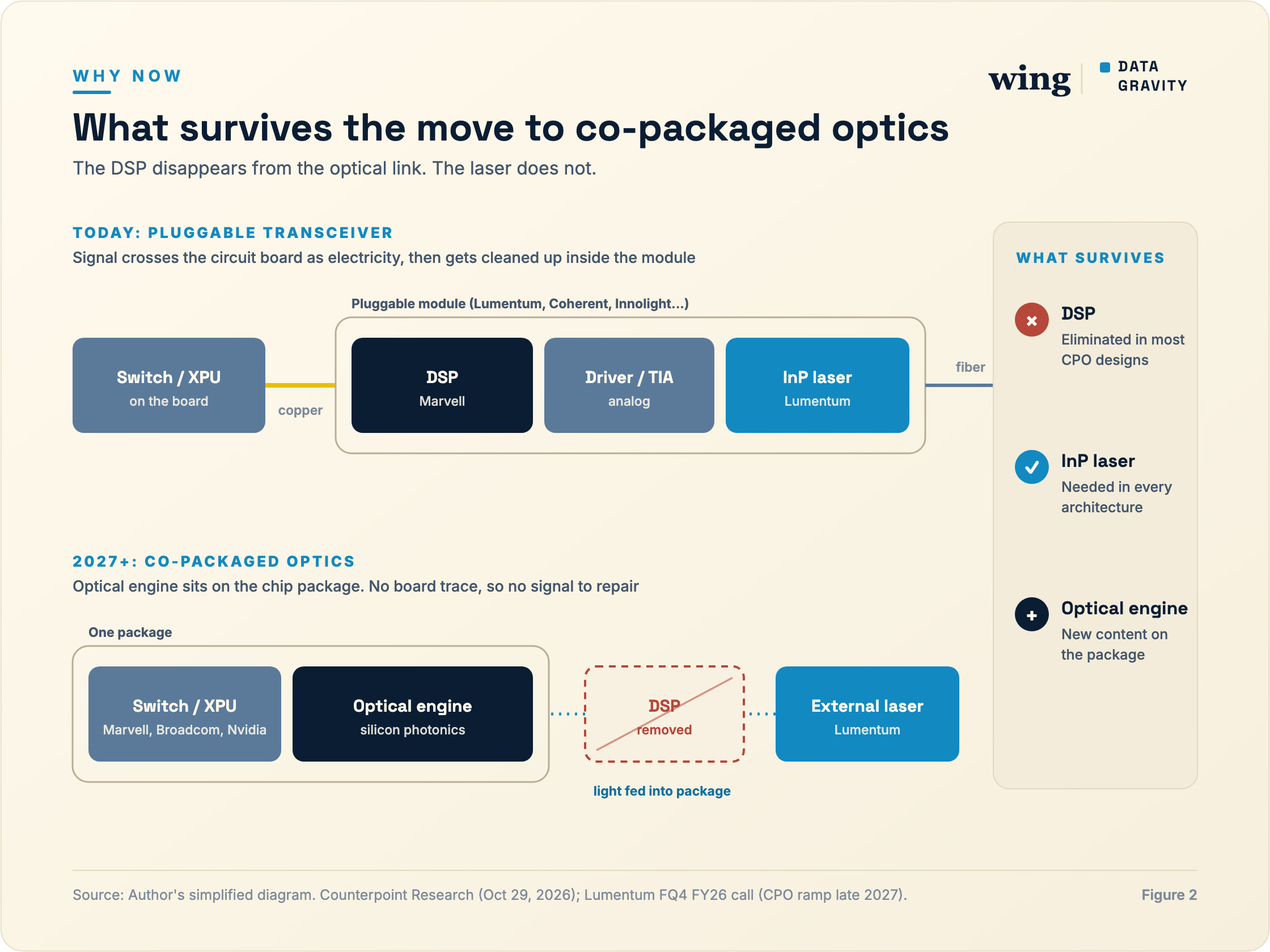
Lumentum expects CPO adoption to pick up in late 2027. The deal closes in the first half of 2028. Marvell is buying the piece of the link that it expects to still be scarce when that transition happens.
2. What Lumentum brings
Lumentum reported earnings the same morning the deal was announced. The numbers explain the price.
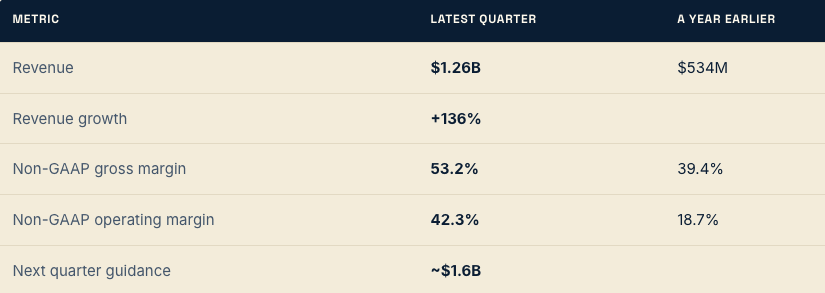
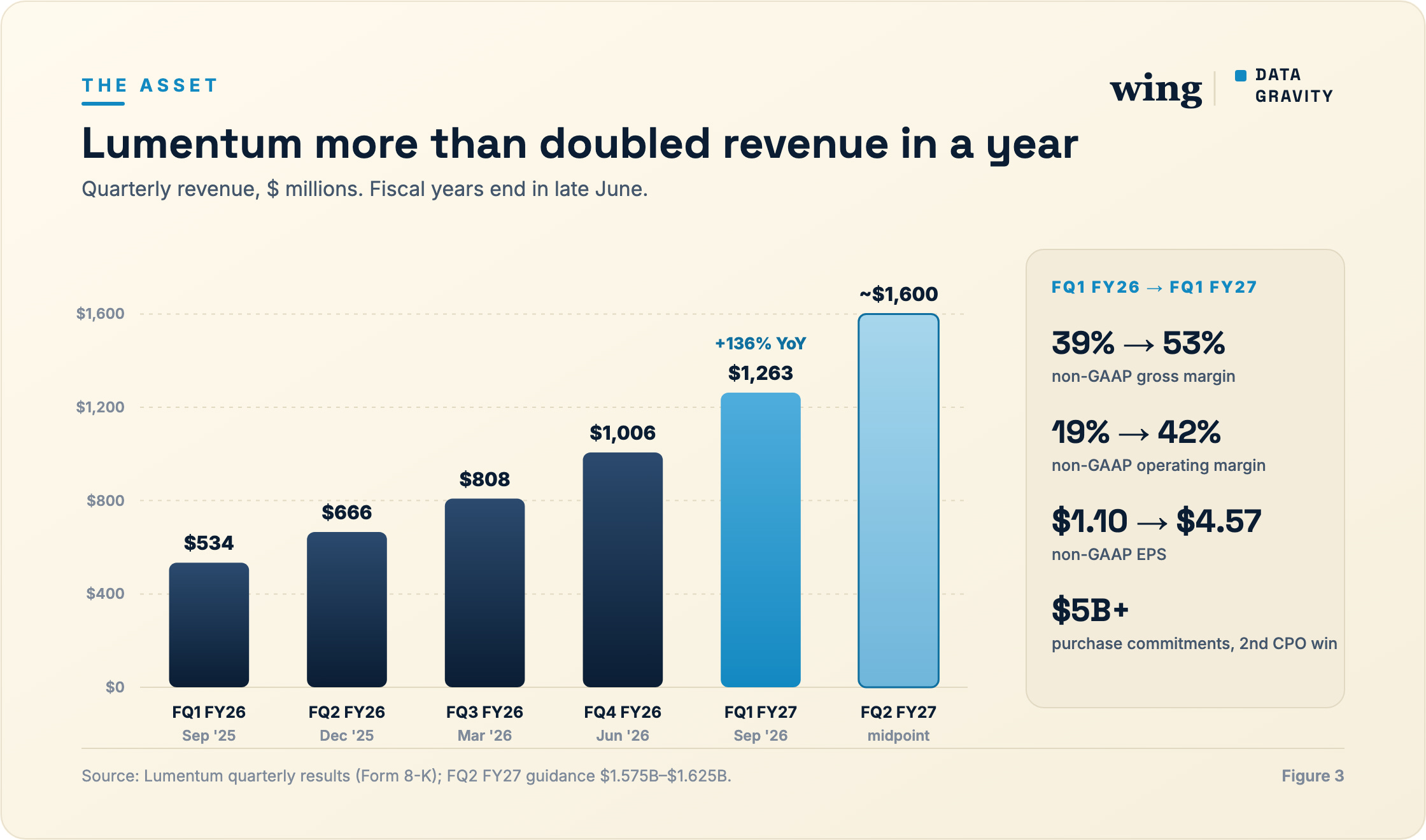
Three details are worth knowing.
Demand is far ahead of supply. Lumentum’s CEO, Michael Hurlston, has said its lasers are sold out through early 2029. He also said the company won’t be able to meet about 70% of demand for some products next year. That is pricing power.
CPO revenue is already committed. Lumentum signed its second large CPO deal last quarter, backed by more than $5B in purchase commitments.
There’s a new product line. Optical circuit switches, which route light with tiny mirrors instead of converting it back to electricity, passed $100M of quarterly revenue for the first time.
3. What the combined company looks like
Neither company gives pro forma numbers yet, so I built a simple run-rate view. I took each company’s latest quarterly guidance and multiplied it by four.
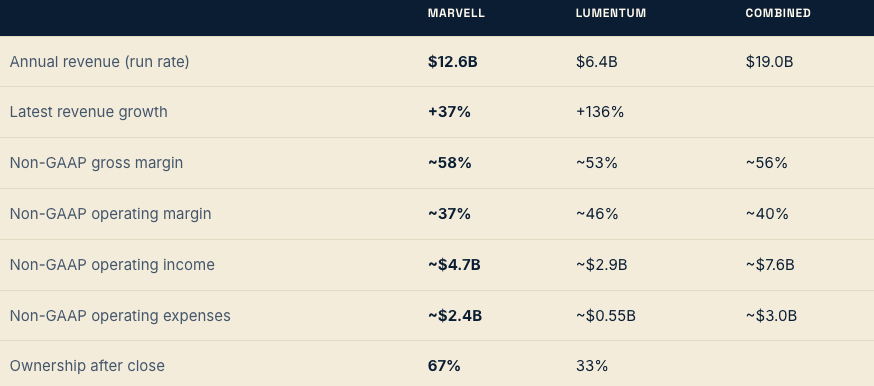
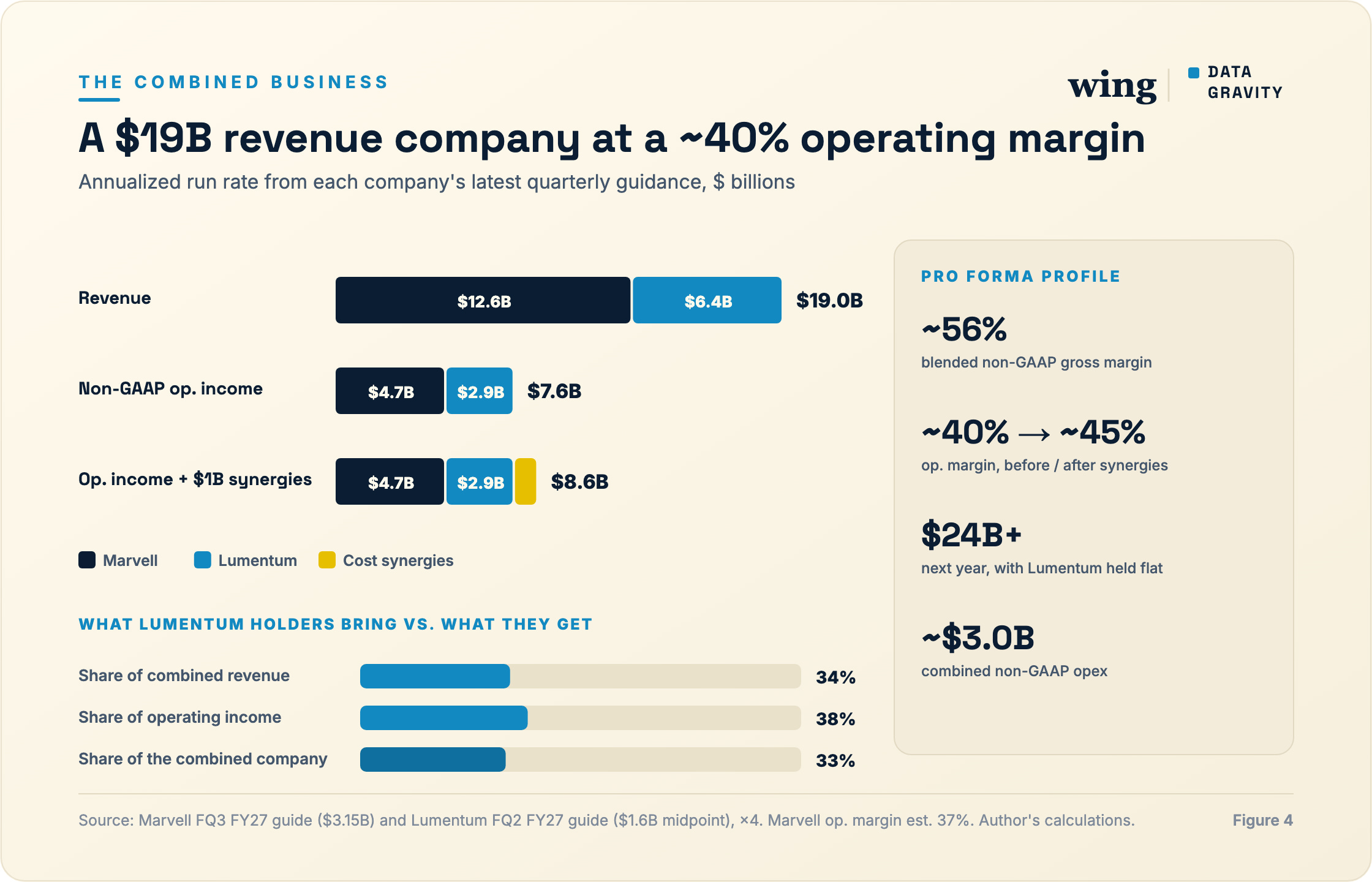
A few things stand out.
It’s a bigger profit engine than it looks. Lumentum is a third of the revenue but nearly 40% of the operating income, because its margins are now higher than Marvell’s.
Next year the company should pass $24B in revenue. Marvell guides its next fiscal year, ending January 2028, to about $18B. Add Lumentum at today’s run rate, with no growth at all, and you get $24B.
The synergy target doesn’t fit into overhead. Marvell is targeting more than $1B a year of cost savings. Lumentum’s entire non-GAAP operating expense base is about $550M a year. So most of the savings has to come from cost of goods: Marvell DSPs going into Lumentum modules at cost, Lumentum lasers going into Marvell’s optical engines at cost, and shared packaging and test. If it works, operating margin moves from about 40% to about 45%.
4. Is the price right?
At the midpoint of next quarter’s guidance, Marvell is paying about 18x Lumentum’s revenue and about 40x its operating income.
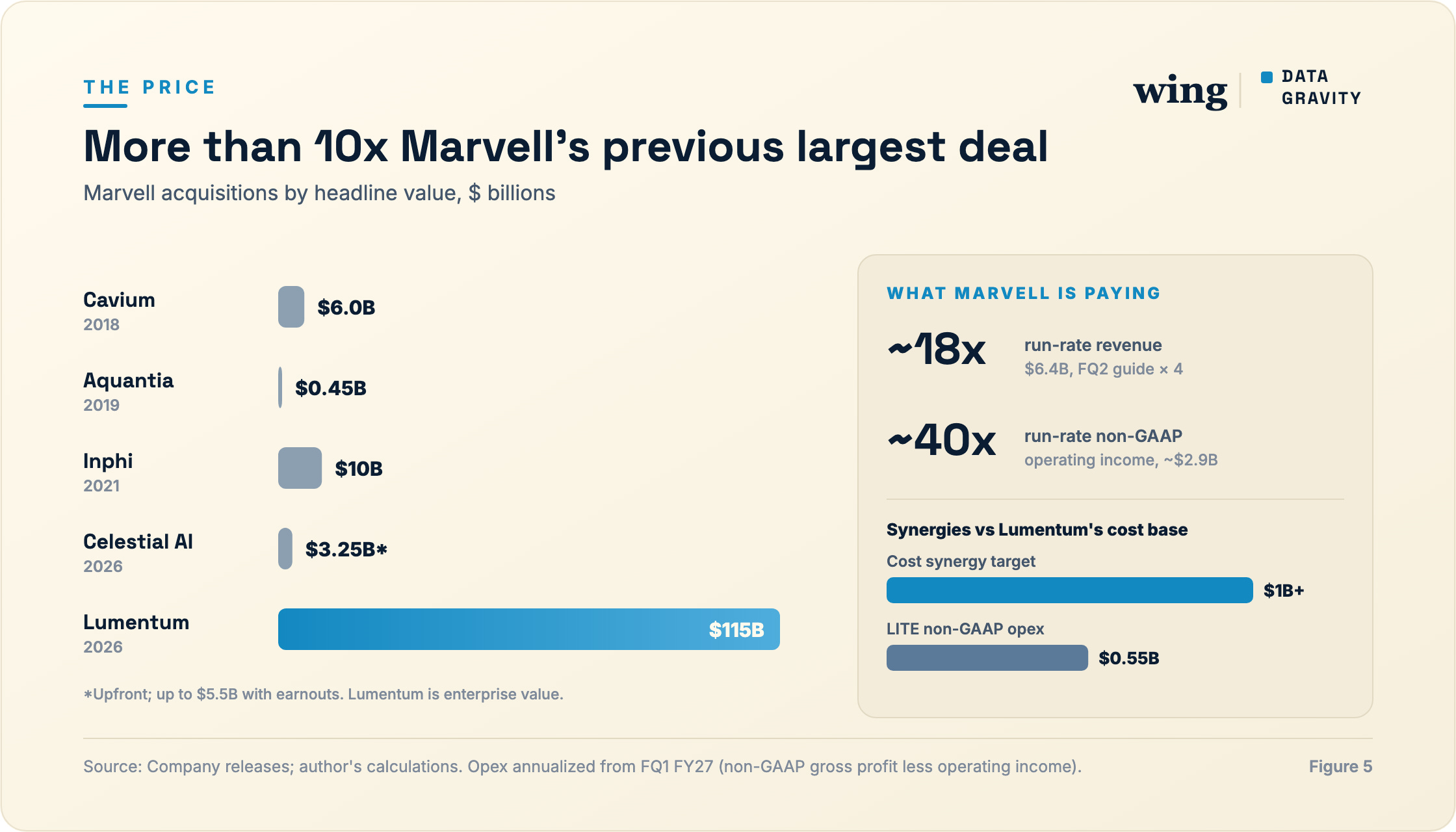
That would be hard to justify in cash. But this is an all-stock deal, so the better question is what Marvell gives up. Lumentum shareholders get 33% of the company. They contribute about 34% of revenue and 38% of operating profit. On those numbers the deal looks roughly fair, and it explains why Marvell says it will add to earnings per share in the first year.
Not everyone agrees. Rosenblatt expects the deal to reduce Marvell’s EPS by 5.0% in 2028 and 2.4% in 2029. Marvell’s stock fell as much as 14% when news of the talks leaked. The disagreement comes down to one question: do Lumentum’s margins hold once laser supply catches up with demand?
5. Who it affects

Broadcom gets a real competitor. After the deal, Marvell can sell a hyperscaler the custom accelerator, the switch, the DSP, the optical engine and the laser. Broadcom has had that full range largely to itself, and it is a big reason Broadcom leads in custom AI chips.
Nvidia has a supply problem to think about. Nvidia invested $2B in Lumentum this year and needs InP lasers for its own CPO switches. Lumentum will soon belong to a company that builds custom chips designed to compete with Nvidia GPUs. Expect Nvidia to buy more from Coherent and help fund new laser capacity elsewhere.
Coherent becomes the main independent laser supplier. Its stock rose 2% on the news.
Marvell may lose some DSP business. Module makers that compete with Lumentum may move DSP orders to Broadcom or Credo. RBC thinks the deal works best if Marvell eventually sells Lumentum’s pluggable module business.
Marvell stops being fabless. Lumentum comes with five InP fabs. Capex goes up and gross margins get more volatile.
Regulators will take their time. China is a big market for both companies, and the 12- to 18-month timeline leaves room for delays.
The bottom line
The constraint in AI infrastructure keeps moving. First it was GPUs, then high-bandwidth memory, then power. Now it’s photons, and specifically the InP lasers that create them. Marvell is paying a full price to own one of the two companies that can make those lasers at scale, before CPO makes its existing optical business smaller.
Why buy: CPO shrinks the DSP market. Lasers are needed in every design.
What you get: A ~$19B revenue business at a ~40% operating margin, with a credible path to $24B+ next year.
What has to go right: Laser supply stays tight, CPO arrives on schedule and the $1B of savings comes through cost of goods.
Who should worry: Nvidia, which now buys a key part from a competitor’s partner, and the module makers that relied on Marvell and Lumentum as neutral suppliers.