


Thesis
The binding constraint on frontier AI has shifted. Through 2023 it was accelerator supply. By 2026 it is the interconnect — and “interconnect” now spans three distinct distance scales at once: chip-to-memory (millimeters), GPU-to-GPU within a rack (meters), and rack-to-rack across a data center hall (tens to hundreds of meters). The fabric moving activations, gradients, KV-cache traffic, and now memory bandwidth itself between tens of thousands of accelerators has to keep all three scales fed simultaneously, fast enough that the silicon never idles waiting on data.
Copper, the default interconnect medium for sixty years of computing, has hit a hard physical limit at the data rates AI clusters now require. A growing field of replacement technologies is racing to fill the gap — silicon photonics, VCSEL-based near-package optics, THz radio-over-wire, and early-stage microLED interconnects among them — and 2026 is the year several of them moved from roadmap slide to shipping product.
Two approaches anchor this piece because they represent the clearest structural bets being made with real capital today: silicon photonics, which converts data to light and is now central to Nvidia’s and Broadcom’s switch roadmaps, and THz radio-over-wire, an approach pioneered by the startup AttoTude (a Wing portfolio company) that drives terahertz-frequency radio signals directly through wire, skipping optical conversion altogether. These are not rivals fighting over a single socket. They sit at different points on the cost, distance, and power curve, and the more durable read — reinforced by how Marvell, Broadcom, and Nvidia are each shipping multiple interconnect formats side by side inside the same switch families — is that several of these approaches will coexist in the AI data center of 2028–2030, often inside the same rack.
The scale of the prize is enormous regardless of which technologies win which sockets. The five largest hyperscalers are on track to spend roughly $725 billion on AI infrastructure in 2026 alone — nearly triple the $256 billion they deployed in 2024 — and networking and interconnect have become a double-digit percentage of total cluster cost rather than a rounding error. Nvidia has put a number on how seriously it takes this: Nvidia has directed roughly $4 billion of capital specifically into optical component suppliers — split into $2 billion stakes in Lumentum and Coherent, paired with multibillion-dollar purchase commitments, future capacity-access rights, and funding for new U.S.-based fabrication facilities, a direct, dollar-denominated bet that the interconnect layer — not the GPU itself — is now the gating factor on how fast it can ship usable AI compute. McKinsey, separately, estimates that EML laser chips will run 40–60% undersupplied through 2027.
The companies that control the bottlenecks in this build-out — manufacturing capacity, component and architecture IP, and systems-level co-design with the largest compute buyers — are re-rating from cyclical component suppliers into structural infrastructure plays. That re-rating is visible in the numbers today, not just the roadmaps.
The numbers that frame the opportunity:
Frontier training clusters in 2026 already run 100,000+ GPUs, with “AI factory” designs targeting millions — and copper’s practical reach collapses as speed rises: Marvell’s own data points put it at roughly 5 meters at 100 Gb/s per lane, ~2.5 meters at 200 Gb/s, and effectively unusable even within a rack at 400 Gb/s.
Hyperscaler AI infrastructure spend is on pace for ~$725 billion in 2026, up from $256 billion in 2024 — and networking and optical interconnect, now a double-digit percentage of total cluster cost rather than a rounding error, represents on the order of $75–100 billion of that spend this year alone.
Nvidia has committed roughly $4 billion directly into optical suppliers, and its Spectrum-X Photonics SN6800 switch reaches 409.6 Tb/s across 512 ports at 800 Gb/s each — with co-packaged optics cutting power consumption by up to 3.5x and improving resiliency 10x versus pluggable architectures.
Marvell’s new Teralynx T100 — the industry’s first 102.4 Tb/s switch built specifically for AI data centers — runs on a 3nm process, draws under 1,000W, and delivers roughly 25% lower power than competing solutions, while shipping in pluggable, co-packaged-copper, and co-packaged-optics configurations side by side.
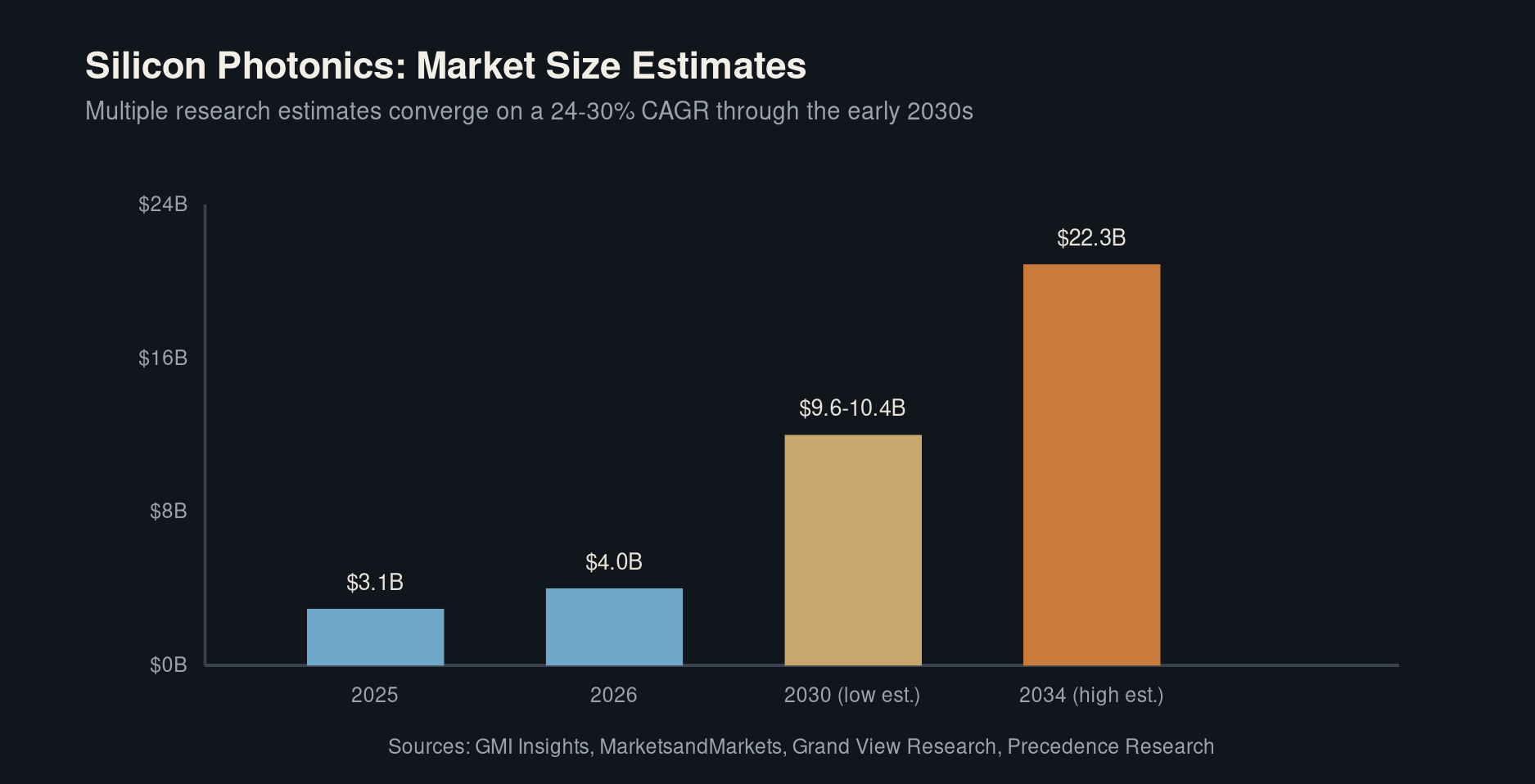
The silicon photonics market is estimated at roughly $3–4 billion in 2025–2026, scaling to $10–29 billion by 2030–2034 (roughly a 27–30% CAGR across the major forecasts — Mordor Intelligence, MarketsandMarkets, Precedence Research, and Polaris Market Research all now cluster in the high-20s, with several houses revising estimates upward through 2026 as AI-specific demand outpaces the telecom- and consumer-driven base case those models were originally built on), while the broader next-generation AI interconnect market — spanning photonics, VCSEL/NPO, THz, and microLED approaches — could exceed $100 billion annually within the decade, according to industry estimates cited around OFC 2026.
AttoTude’s THz radio-over-wire approach reports per-lane speeds up to 448 Gb/s and reach up to 40 meters directly over wire — without an optical conversion stage.
The Copper Wall: Why Electrons Stop Scaling
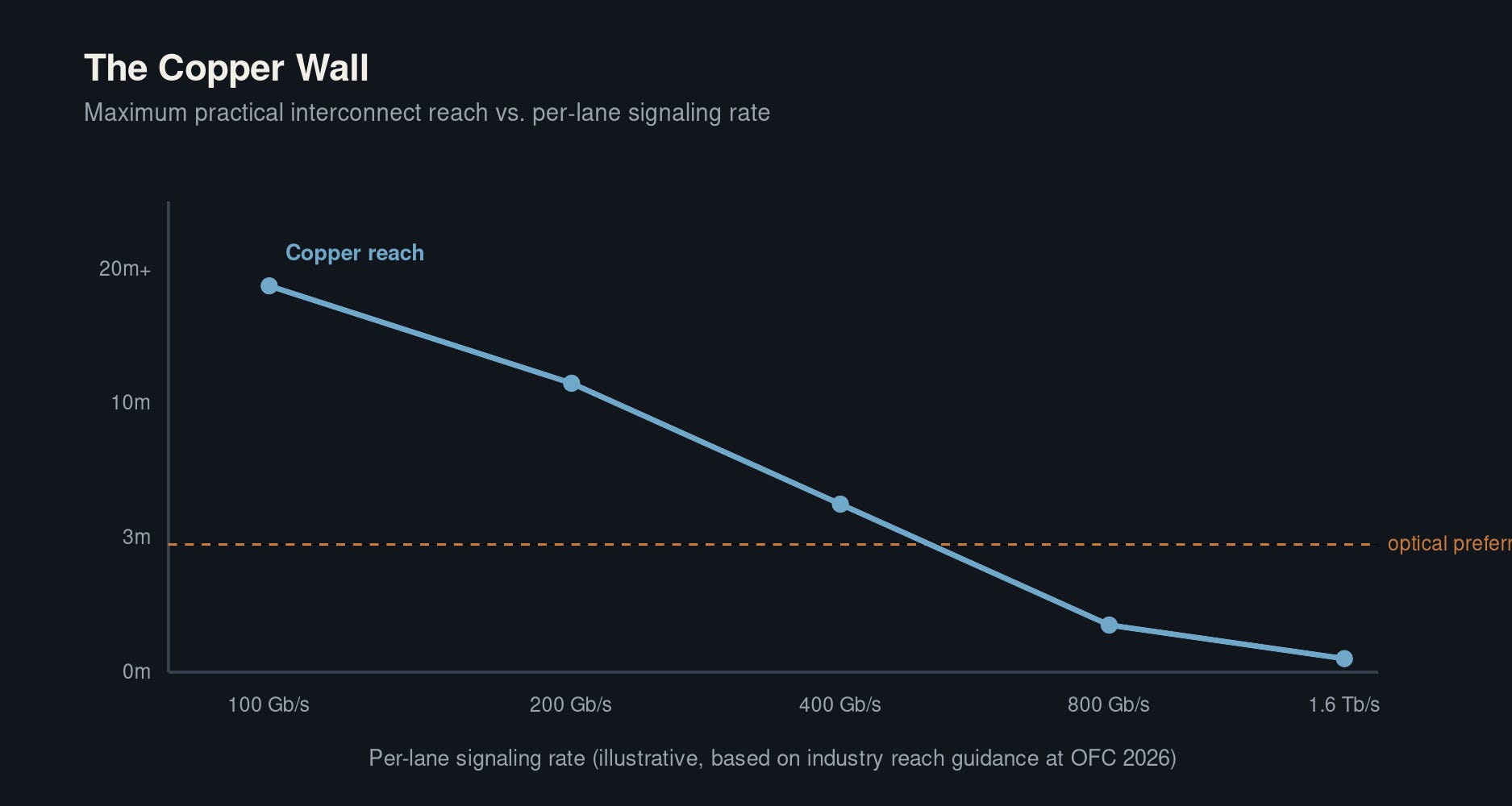
Copper interconnects move data by modulating voltage on a wire — a mechanism that degrades predictably, and non-linearly, as both frequency and distance rise. Marvell CEO Matt Murphy put concrete numbers on this at his Computex 2026 keynote: copper can carry a signal roughly 5 meters at 100 Gb/s per lane, but that reach falls to about 2.5 meters at 200 Gb/s, and at 400 Gb/s copper can no longer reliably make connections even within a single rack. Each time this threshold moves, Murphy argued, the number of links that must convert to optical increases by at least an order of magnitude — which is what is now driving what he called an “explosive” demand cycle across the optics supply chain, with Taiwan’s manufacturing base already expanding in response.
This is the “copper wall,” and it is a property of physics that worsens, not improves, as model and cluster sizes grow. Beyond roughly three meters of reach, attenuation and heat dissipation make copper a net negative versus the alternatives; at million-GPU scale, the share of total system power and latency consumed by electrical interconnect stops being an afterthought and becomes the dominant design variable.
Every replacement technology in this piece — optical, VCSEL-based, THz-over-wire, or microLED — exists because it sidesteps this specific failure mode, via different physical mechanisms. Photons don’t suffer resistive loss the way electrons do. THz-frequency radio signals can be engineered to traverse wire with substantially less of the attenuation that kills copper at lower frequencies. And the industry’s accelerating search for more than one way around this wall is itself the signal: when an entire supply chain starts hedging across several physical bets simultaneously, that is usually a sign the old approach is genuinely exhausted, not just temporarily expensive.
Why This Matters Specifically for Large Models
Transformer-based models are bottlenecked as much by communication as by computation. Mixture-of-experts architectures, tensor and pipeline parallelism, and disaggregated inference — separating prefill from decode across different hardware pools — all multiply east-west traffic between accelerators relative to the FLOPs actually executed. As clusters scale from thousands to hundreds of thousands of GPUs, the ratio of interconnect bandwidth to compute, not raw FLOPs, increasingly determines effective utilization.
Nvidia has made this an explicit architectural priority. Its Quantum-X InfiniBand switches (early 2026) and Spectrum-X Photonics Ethernet switches (second half of 2026, built on the Spectrum-6 ASIC) integrate co-packaged optics directly onto the switch silicon. The flagship SN6800 reaches 409.6 Tb/s across 512 ports at 800 Gb/s — bandwidth that would be physically and thermally impossible to deliver with discrete pluggable copper or pluggable optical modules at that density. Nvidia states CPO cuts power consumption by up to 3.5x and improves resiliency 10x versus conventional pluggable architectures, with its longer-range roadmap following TSMC’s COUPE packaging program toward 6.4 Tb/s at the board level.
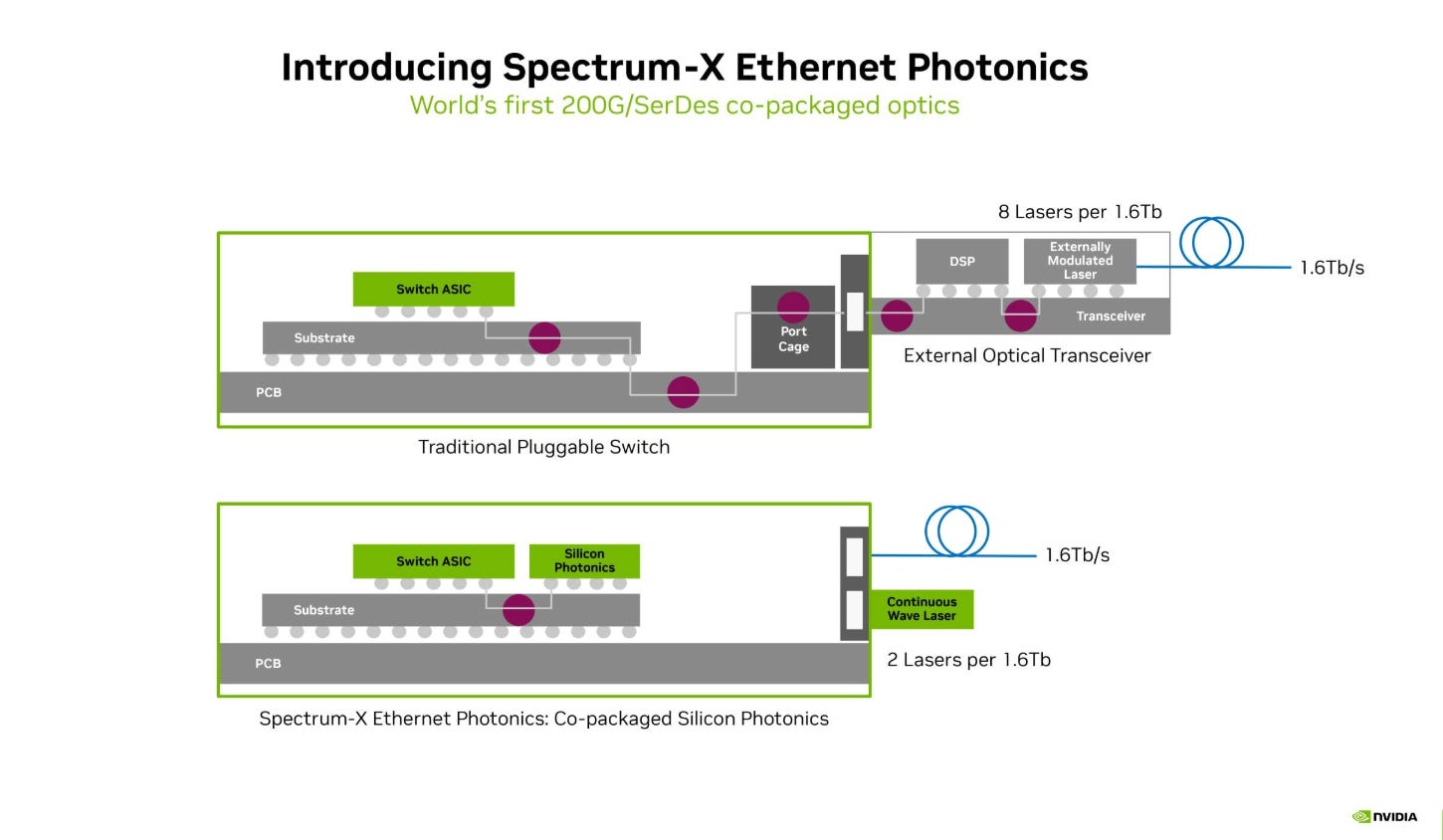
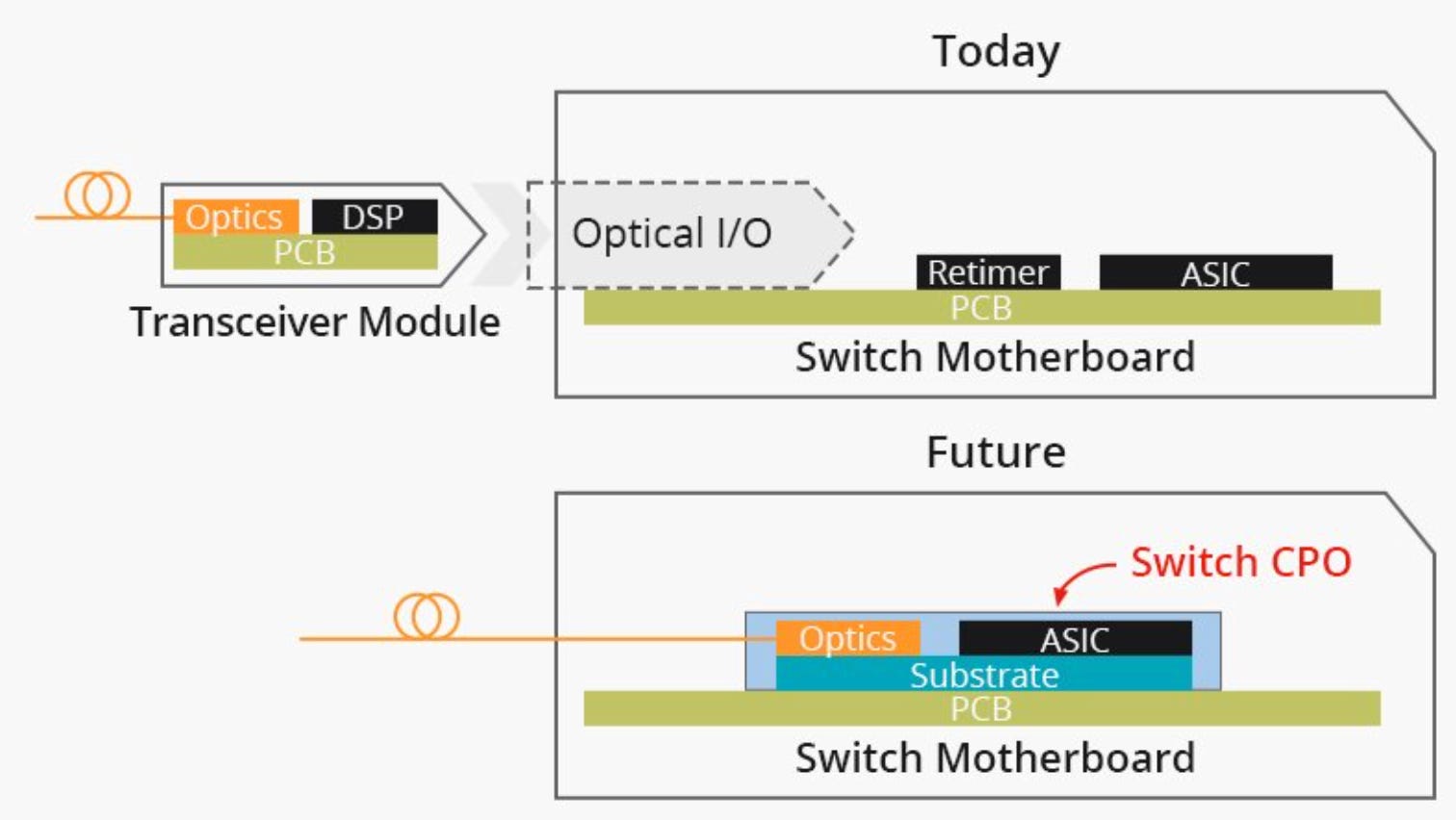
Nvidia’s own architecture diagrams make the structural shift legible at the component level. A traditional pluggable switch routes signal from the switch ASIC, across the substrate, through a port cage, into an external optical transceiver — DSP, externally modulated laser, and all — needing eight separate lasers per 1.6 Tb/s of bandwidth. Spectrum-X Ethernet Photonics collapses that chain: the silicon photonics engine sits directly on the substrate beside the switch ASIC, driven by a continuous-wave laser, and the same 1.6 Tb/s now requires just two lasers — a quarter as many laser sources, connectors, and potential failure points, assembled in far fewer steps.
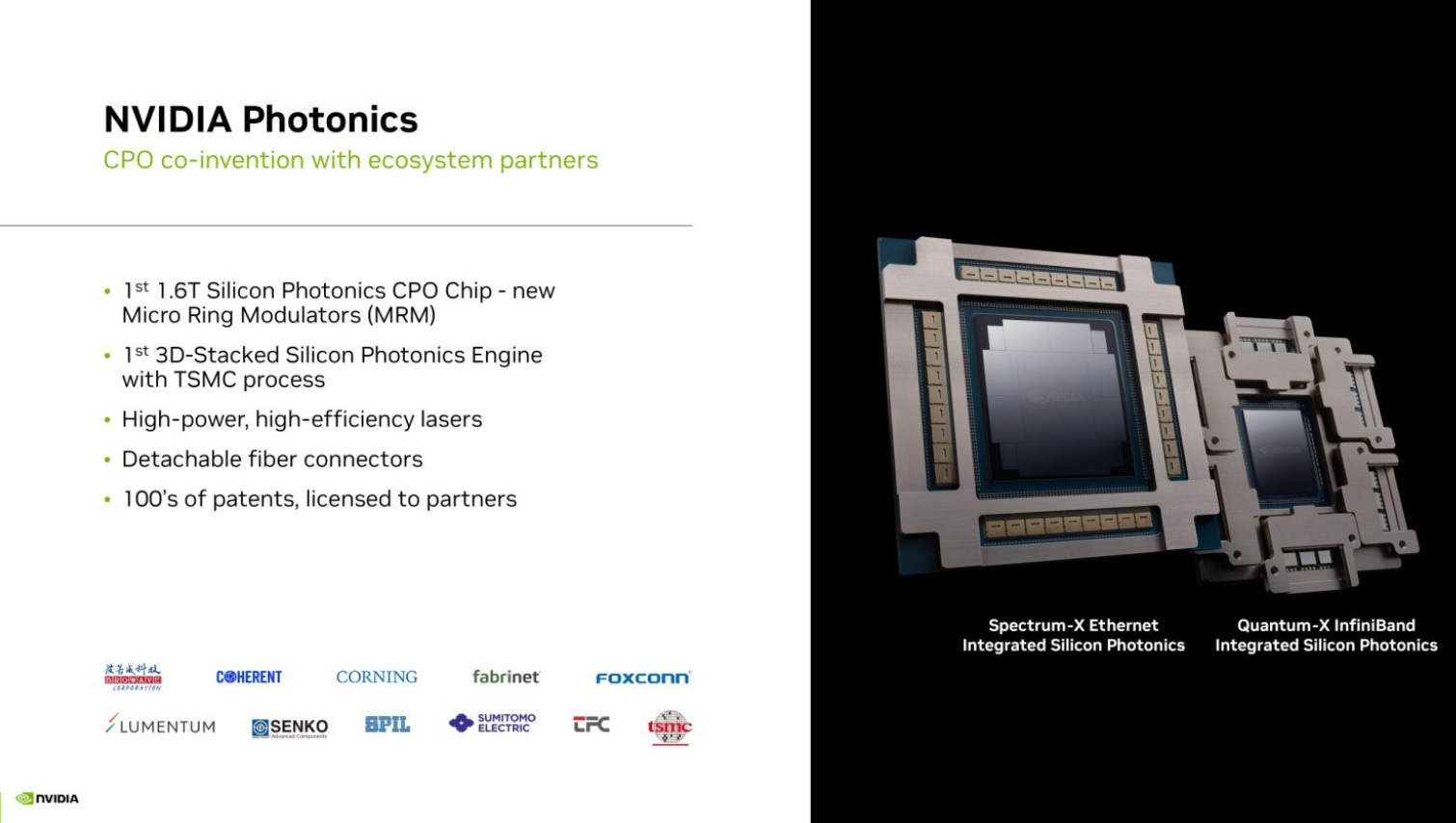
Crucially, this is no longer a future-tense story. Nvidia’s Vera Rubin platform has already adopted Spectrum-X Ethernet Photonics — the first CPO-based switch to enter mass production — which is the clearest evidence yet that co-packaged optics has crossed from proof-of-concept into actual commercial deployment. Nvidia’s own roadmap materials describe this as “CPO co-invention with ecosystem partners”: the first 1.6T silicon photonics chip built around new micro-ring modulators, the first 3D-stacked photonics engine built on TSMC’s process, high-power high-efficiency lasers, detachable fiber connectors for serviceability, and — the detail that matters most structurally — hundreds of patents licensed out to a roster spanning Coherent, Lumentum, Corning, Fabrinet, Foxconn, Sumitomo Electric, Senko, and TSMC, rather than held closed. That is Nvidia subsidizing and standardizing the supply chain underneath its own roadmap, the same playbook it has used with CUDA and NVLink — turning would-be competitors and suppliers into an ecosystem with a shared interest in its architecture winning.
The largest buyer of AI compute has told the market, in shipping silicon, capital commitments, and licensed IP, that the interconnect layer is no longer a procurement afterthought. It is now co-designed with the compute itself — and as optical connectivity extends further into the server, closer to the chip-to-memory link itself, it opens the door to disaggregating compute, memory, and networking entirely, and operating the data center less like a collection of fixed servers and more like a single, dynamically configurable system.
The Near-Term Bridge: VCSEL-Based Near-Package Optics
Co-packaged optics is the destination, but it is not yet the easiest way to ship volume today — CPO requires new packaging, new yield curves, and new supply chains to mature simultaneously. Broadcom’s answer to that gap is VCSEL-based Near-Package Optics (NPO): optical engines built on vertical-cavity surface-emitting lasers, mounted close to — but not integrated into — the switch package.
The appeal is pragmatic rather than visionary. VCSELs are a mature, high-volume, field-proven technology already manufactured at scale for 100G multi-mode applications, which means NPO can be deployed today on proven supply chains rather than waiting for CPO’s packaging ecosystem to mature. Broadcom’s 3.2T VCSEL-based NPO solution is positioned explicitly as a bridge: lower cost and lower power than legacy pluggables, small enough to preserve architectural flexibility, and good enough on wall-plug efficiency across a wide range of speeds that it doesn’t force operators to make an all-or-nothing bet on CPO timelines. For investors, NPO is worth tracking less as a long-term technology winner and more as a signal of sequencing — it is the architecture the industry is choosing to absorb demand while CPO’s manufacturing base catches up, and the companies supplying it (Broadcom prominently among them) get a multi-year revenue bridge while the bigger structural transition plays out underneath.
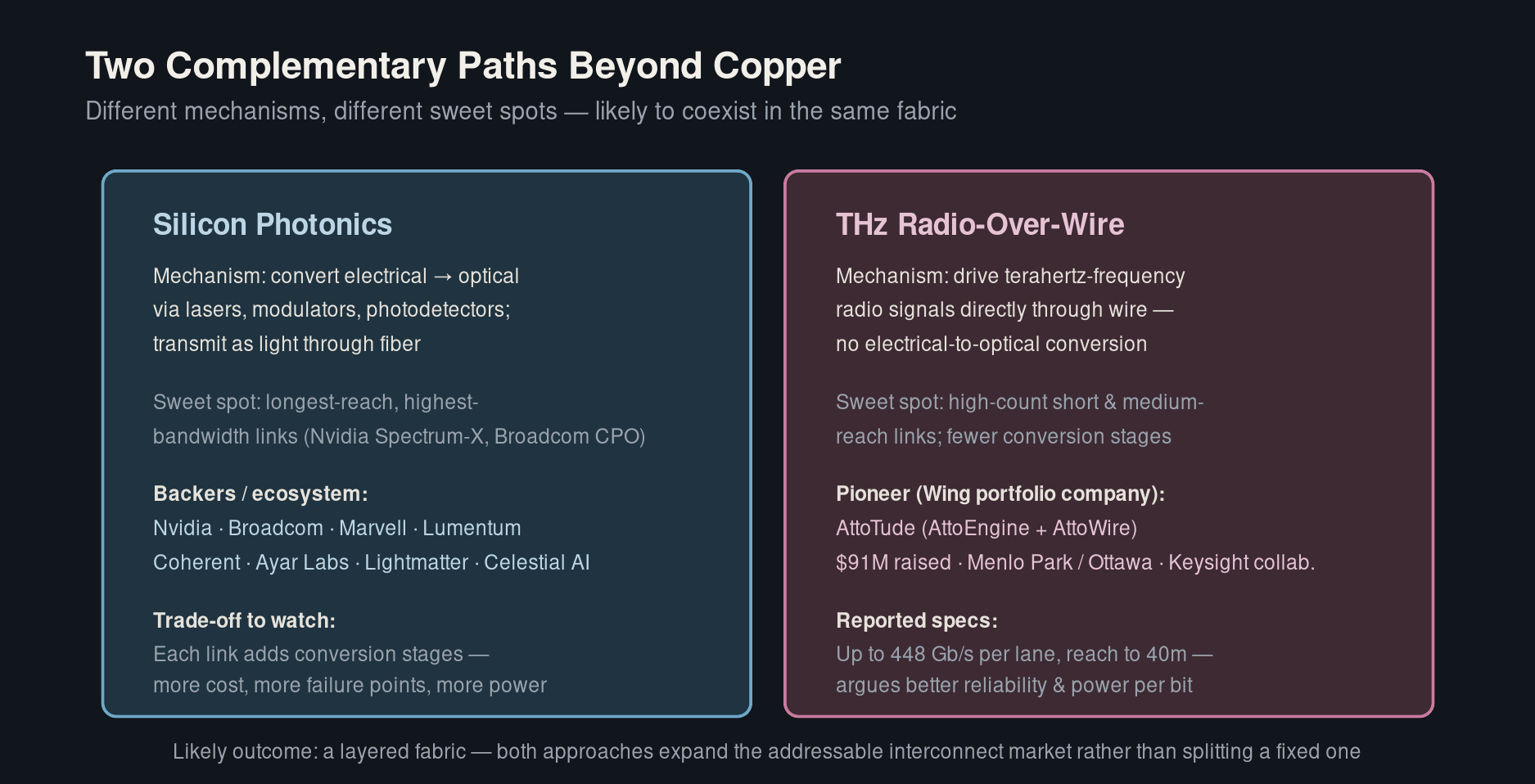
Two Complementary Paths Beyond Copper: Photonics and THz Radio-Over-Wire
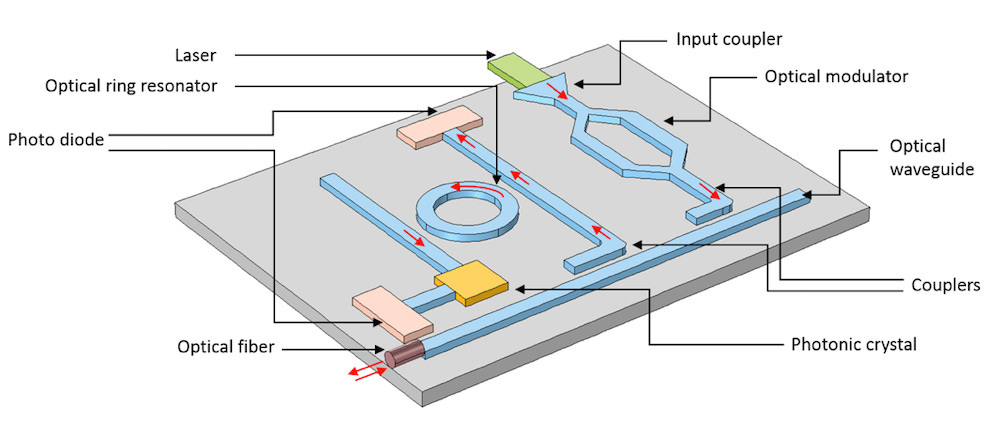
It is worth grounding this in what a photonic chip actually is at the component level, since the term gets used loosely. A photonic integrated circuit replaces copper traces with optical waveguides etched directly into the chip: a laser generates light, an optical modulator encodes data onto it, ring resonators and couplers route and filter individual wavelengths, and a photodiode converts the signal back into an electrical one at the receiving end — all stages that copper interconnects simply don’t need, and all stages that have to be manufactured, packaged, and yielded at volume for any of this to ship at AI-cluster scale. That manufacturing complexity is precisely why the foundry and packaging layer (Tower, Fabrinet, TSMC) sits at the center of this entire build-out, not on its periphery.
Photonics is the approach getting the largest share of funding and standards attention today — Nvidia, Broadcom, TSMC, and the GF Fotonix coalition are all building toward it — and it is genuinely the right tool for the longest-reach, highest-bandwidth links, where the cost and complexity of converting electrons to light is worth paying. The more interesting story for 2026, though, is what is emerging alongside it.
AttoTude — a Menlo Park-based startup, and a Wing portfolio company — has built what we think is one of the more elegant architectural answers to the copper wall: THz radio-over-wire. Rather than converting electrical signals to light and back again, its AttoEngine drives terahertz-frequency radio signals directly through ordinary wire (AttoWire), borrowing the high-frequency design discipline of photonics while skipping the optical conversion stage entirely — along with the laser sources, modulators, and photodetectors that stage requires. It is a genuinely novel piece of systems engineering: getting radio signals to behave at terahertz frequencies over wire, at the reliability and reach AttoTude reports, is a hard problem that very few teams in the world are positioned to solve.
The result is a technology with real, differentiated advantages where it counts. The company reports per-lane speeds up to 448 Gb/s and reach up to 40 meters directly over wire — covering a substantial share of intra- and inter-rack distances — with fewer conversion stages translating directly into better reliability and lower power draw per bit than an optical link of comparable reach. That is not a marginal efficiency story; removing an entire conversion stage from the signal chain is the kind of structural advantage that compounds at scale. The company has raised $91 million to date across seed, Series A, and a $50 million Series B in 2026, and has begun a signal-analysis collaboration with Keysight — concrete signs of a credible, fast-moving, well-capitalized program with a genuine technical edge, not a paper architecture chasing a trend.
The practical picture for the AI data center of 2028–2030 is a layered fabric, not a winner-take-all contest: photonics carrying the longest-reach, highest-bandwidth links where its cost is justified, and AttoTude’s THz radio-over-wire taking on the shorter- and medium-reach links — a much larger share of total connections by sheer count — where a simpler, more reliable, more power-efficient signal chain is the deciding factor. Both approaches expand the addressable interconnect market rather than splitting a fixed one. We think AttoTude’s approach is one of the more capital-efficient and structurally advantaged ways to attack that expanding market, and it is the one we have backed.
On the Horizon: MicroLEDs — the Step After NPO
The sequencing logic that makes VCSEL/NPO a credible bridge today points to a follow-on question: what comes after CPO and NPO both reach volume? The most-cited answer at OFC and Computex 2026 was microLED-based optical interconnects — and it’s worth naming for exactly that reason, not as a standalone bet. Companies including Avicena, Kopin (in partnership with Fabric.AI), and MediaTek showcased microLED architectures, pitching them as a lower-power, higher-density alternative to laser-based optics for the shortest-reach, highest-count links inside the rack — precisely the segment where Tower’s and Fabrinet’s foundry constraints bite hardest, and where a non-laser-based approach could meaningfully ease the precision-assembly bottleneck described above. Fabric.AI has targeted a late-2026 demonstration of its “Neural I/O” platform, and at OFC 2026 every hyperscaler in attendance reportedly named I/O density as their central interconnect concern — with most specifically naming microLEDs as the candidate for that next step.
The honest framing: microLEDs are real enough to take seriously as a multi-year theme, and early enough that naming a winner today would be guessing. They belong on the watch-list — not as a fourth horse in this race, but as the clearest signal that the industry already assumes today’s CPO/NPO generation is a way-station, not an endpoint. That assumption, more than any single technology bet, is what should anchor a multi-year view of this space: the interconnect problem is durable enough that the industry is already funding its own replacement before the current generation has even shipped at volume.
Lumentum and Coherent: The Incumbent Optical Suppliers Re-Rating on AI
Lumentum and Coherent are the two large-cap, pure-play optical component companies riding the photonics side of this cycle most directly, and their recent results show the re-rating happening in real time.
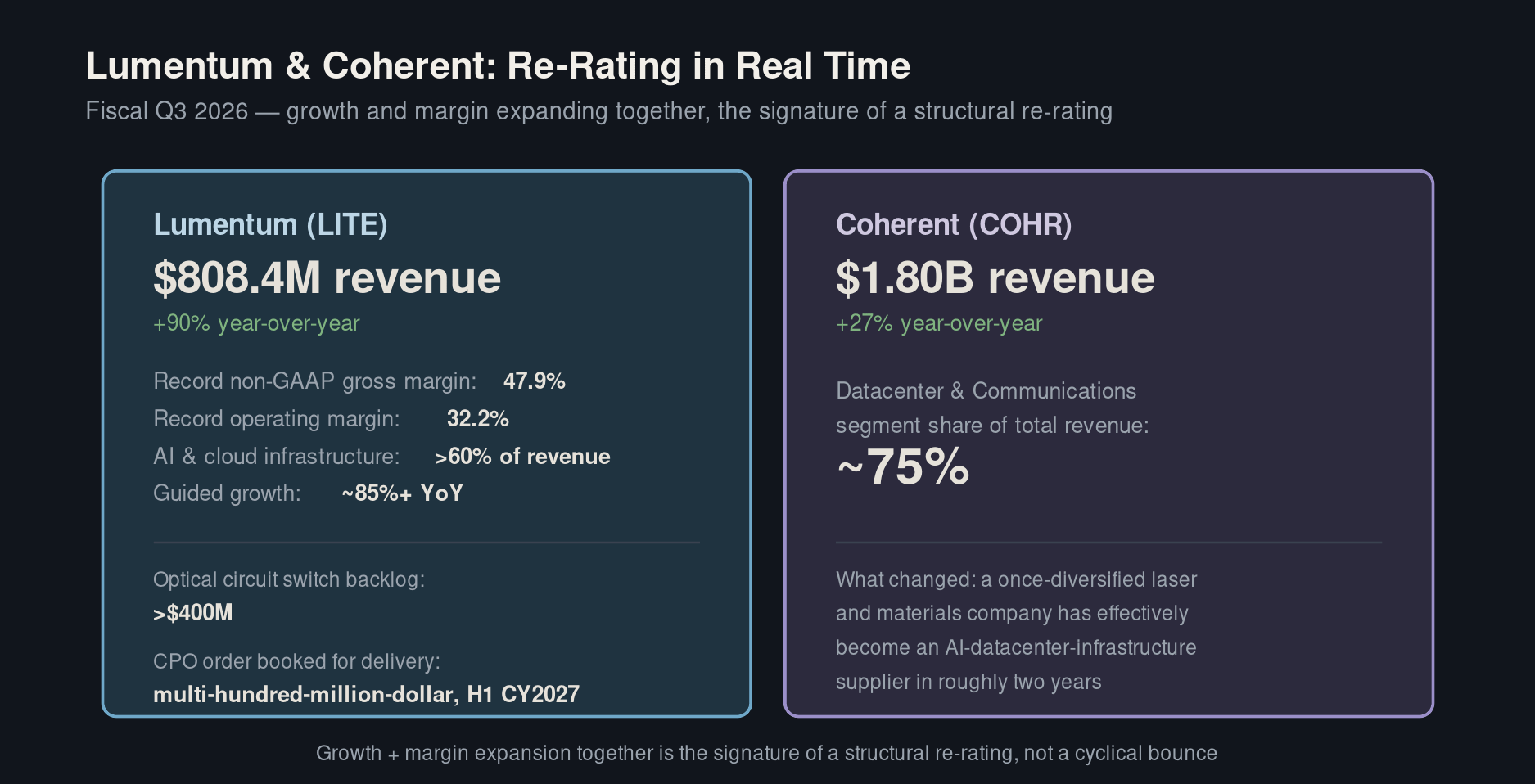
Lumentum’s fiscal Q3 2026 revenue rose 90% year-over-year to $808.4 million, with non-GAAP gross margin and operating margin both hitting record highs of 47.9% and 32.2% — a margin profile that looks far more like a systems company than a commodity transceiver vendor. AI and cloud infrastructure now account for over 60% of Lumentum’s revenue, and management guides to roughly 85%+ year-over-year growth, anchored by two emerging product lines: optical circuit switches (backlog exceeding $400 million) and co-packaged optics, where it has booked a multi-hundred-million-dollar CPO order for delivery in the first half of calendar 2027.
Coherent posted Q3 FY26 revenue of $1.80 billion, up 27% year-over-year, with its Datacenter & Communications segment now generating roughly 75% of total revenue — effectively transforming what was once a diversified laser and materials company into an AI-datacenter-infrastructure supplier.
Both illustrate the same underlying shift: optical components have moved from a line item inside networking budgets to a primary determinant of how many GPUs a data center can actually utilize. The companies that can manufacture at the precision and volume AI clusters require are capturing share and margin simultaneously — and that combination, growth plus margin expansion, is the signature of a re-rating, not a cycle.
It would be incomplete, though, to frame this as a US-only story. Innolight (Eoptolink’s larger rival) is the global volume leader in 800G optical modules, with roughly 35% share of 2026 shipments, and posted FY2025 net profit up 108% year-over-year (and a further 262% in Q1 2026) — figures that rival or exceed the Western incumbents’ growth rates on a much larger unit base. Together, Innolight and Eoptolink supply an estimated 60% of Nvidia’s incremental 800G module orders, which means two Chinese manufacturers — not Lumentum or Coherent — currently control the single largest swing factor in how fast Nvidia can actually ship racks. Innolight’s 800G silicon photonics modules reportedly run yields above 92% at under 14W per module; Eoptolink’s linear pluggable optics cut power roughly 50% versus conventional designs and have already won orders from Meta and Amazon. The uncomfortable fact sitting underneath the Lumentum/Coherent re-rating story, then, is this: two Chinese manufacturers — not the Western component names investors gravitate toward — currently control the single largest swing factor in how fast Nvidia can actually ship racks, and the US re-shoring efforts described above are aimed at changing that over a multi-year horizon, not next quarter.
The Manufacturing Layer: Tower and Fabrinet Hold the Real Bottleneck
Behind the component brands sits a manufacturing and foundry layer that is arguably the more interesting story about who actually controls supply — because Tower Semiconductor and Fabrinet are, functionally, the bottleneck the entire interconnect re-rating runs through. Every optical architecture discussed in this piece — Nvidia’s CPO roadmap, Lumentum’s and Coherent’s component lines, Marvell’s and Broadcom’s switch programs — ultimately needs precision photonic and analog assembly at volumes that only a small number of foundries on earth can deliver. (AttoTude’s radio-over-wire approach is a structural exception worth noting here: by skipping the optical conversion stage entirely, it sidesteps this specific bottleneck — one more way its architecture diverges from, rather than competes directly with, the photonics supply chain.) Tower and Fabrinet sit directly across that chokepoint, which is what gives their backlogs the multi-year visibility and pricing power described below.
Tower Semiconductor has signed $1.3 billion in silicon photonics contracts for 2027 delivery from its largest customers, backed by $290 million in prepayments for capacity reservation — a financing structure that signals real scarcity, not speculative demand. Tower is guiding to a 2028 model of $2.8 billion in revenue and $750 million in net profit, levered substantially to its silicon photonics and silicon-germanium BiCMOS platforms.
Fabrinet, the contract manufacturer that assembles a large share of the industry’s optical transceivers, reported Q2 FY26 optical communications revenue up 29% year-over-year to roughly $833 million, with management projecting AI optics programs alone will exceed $150 million per quarter and that its new Chonburi Building 10 will push next-generation AI optics to over 50% of total revenue exposure.
These are capacity-constrained businesses in a capacity-constrained industry — precisely the setup that produces durable pricing power and multi-year revenue visibility once a backlog is booked. And it is a layer that benefits regardless of which architecture ultimately wins more share, since photonics, VCSEL/NPO, THz-over-wire, and microLEDs all require precision packaging at volumes only a handful of foundries can deliver.
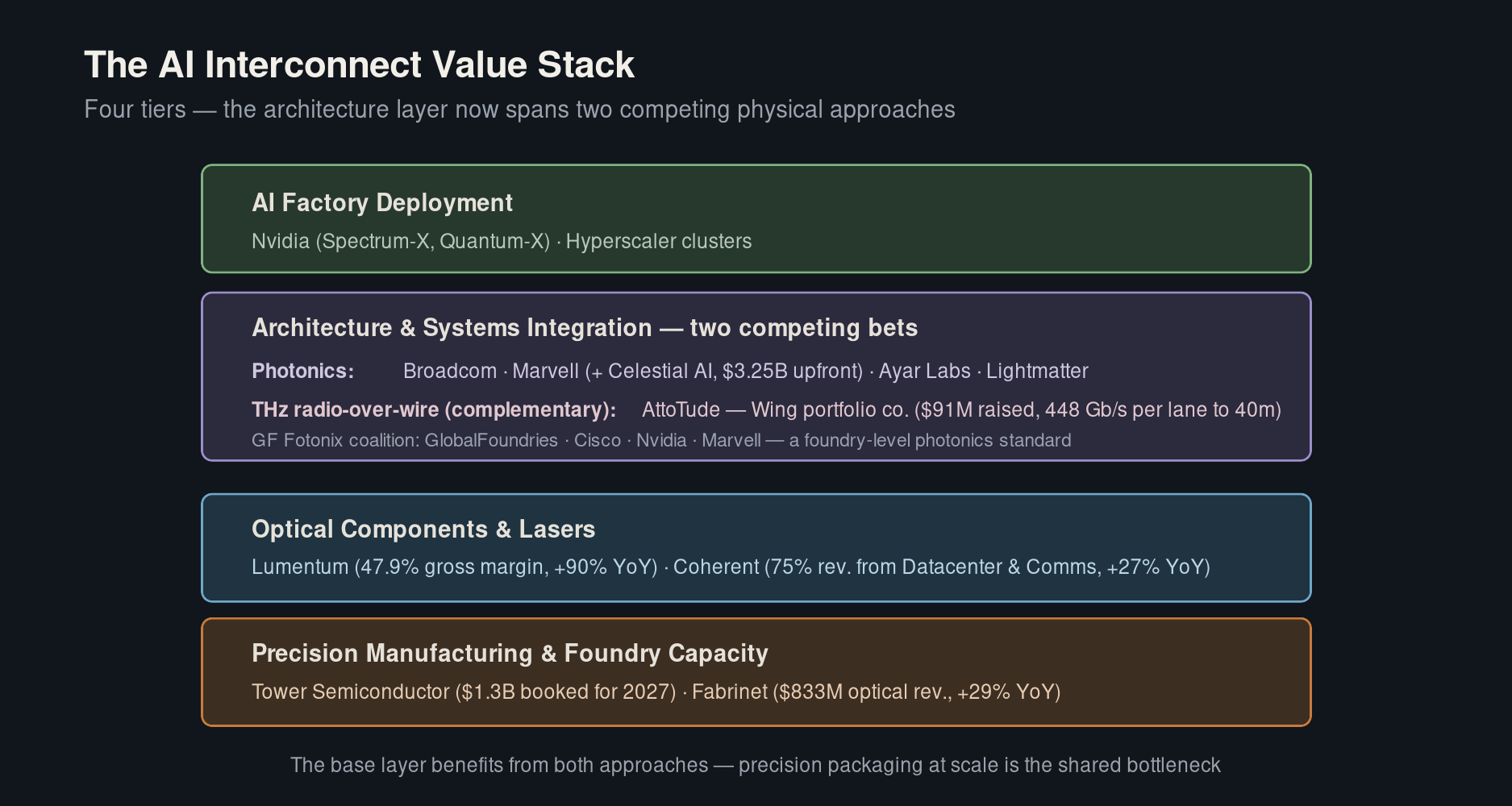
The Architecture Race: Who Controls the Next Layer Up
The next layer up — system architecture, not component supply — is where the long-term winners will actually be decided, and 2026 produced the clearest signal yet of how seriously the largest semiconductor incumbents, switching vendors, and venture-backed challengers all take it.
Marvell laid out the most explicit thesis of the year. At Computex 2026, CEO Matt Murphy argued that AI infrastructure has moved through two prior bottlenecks — first compute (which built Nvidia), then memory — and that connectivity is next, because compute performance gains are now outpacing networking gains. He positioned Marvell as the only company able to address the entire connectivity stack of an AI data center, “from millimeter scale inside the package to kilometer scale between data centers,” and pointed to roughly $36 billion in cumulative M&A — including Inphi, Cavium, and now Celestial AI — as the basis for that claim.
It’s an assertive pitch — worth weighing against the fact that a CEO laying out a “we’re the only ones who can do this” thesis at a flagship keynote has every incentive to make the addressable market sound as large, and Marvell’s position in it as singular, as possible. The technical case behind it is more concrete: Marvell detailed the engineering stack behind its Coherent optical modules — fourth-generation silicon photonics, advanced CMOS DSP, and silicon-germanium broadband analog, integrated together rather than sourced piecemeal — which is the kind of vertically-integrated stack that’s genuinely hard to replicate, and the strongest evidence for the thesis independent of how Murphy chose to frame it.
That M&A thesis runs directly through Celestial AI, which Marvell has now brought in for a headline value of roughly $5.5 billion — though a meaningful share of that figure is performance-contingent earnout rather than committed capital. The acquisition buys Marvell the “Photonic Fabric” technology, built around an “Optical Multi-Chip Interconnect Bridge” that lets any point on one die connect optically to any point on another — the clearest evidence yet that the largest players see optical chip-to-chip interconnect as core infrastructure worth owning outright, not a component to be sourced.
Marvell also used Computex to ship hardware, not just thesis: the Teralynx T100, the industry’s first 102.4 Tb/s switch purpose-built for AI data centers, runs on a 3nm process, draws under 1,000W, and delivers roughly 25% lower power than competing solutions — available in conventional pluggable, co-packaged-copper, and co-packaged-optics configurations side by side, which is itself a tell about how unsettled the near-term architecture question still is even for the companies building it.
Around Marvell’s moves, the rest of the field is moving fast too. Lightmatter raised $155 million in a Series C and has positioned its “Passage” 3D photonic interposer — featuring dense wavelength-division multiplexing and co-packaged optics — to target supercomputers scaling to roughly 300,000 nodes. Ayar Labs, backed by both Nvidia and AMD, closed a $500 million Series E in March 2026 (total funding $870 million, valuation $3.75 billion) explicitly to scale volume production of optical chiplet interconnects — a clear signal that the largest compute vendors see independent optical I/O providers as strategically necessary rather than redundant to their in-house programs. Broadcom, pursuing both CPO and the nearer-term VCSEL/NPO bridge from the switch-ASIC side, and Marvell, now doubling down through Celestial AI and the GF Fotonix platform (alongside GlobalFoundries, Cisco, and Nvidia), are — per IDTechEx — locked in what is likely the defining strategic contest in the sector through the end of the decade.
Arista Networks is making the same bet from the switching side, with a pluggable-first lens. Rather than racing straight to co-packaged optics, Arista is pushing high-density liquid-cooled pluggable optics — its new XPO platform reaches 12.8 Tbps per module, a 4x front-panel density jump over current 1.6T OSFP designs (204.8 Tbps per OCP rack unit), while management says the architecture cuts AI networking racks by up to 75% and floor space by up to 44% versus conventional pluggable deployments. Arista’s framing matters because it is effectively a referendum on sequencing, not direction: the company is betting that liquid-cooled, ultra-dense pluggables can absorb several more product cycles of bandwidth growth before the industry is forced into the harder packaging and yield problems CPO still has to solve. That’s a more conservative read of the same transition Nvidia and Broadcom are pricing in by going straight at co-packaged designs — and for investors, Arista is the cleanest test of whether “good enough, shipping now” beats “structurally better, shipping later” in this specific cycle — and the fact that a switching incumbent of its scale is still betting heavily on pluggables is itself a data point that the CPO transition will be slower and more contested than the most aggressive roadmaps imply.
One more layer worth tracking beneath the architecture race: multi-wavelength lasers, which attack the bandwidth problem by putting more colors of light on a single fiber rather than more fibers in a bundle. Xscape Photonics raised $37 million in new funding in March 2026 (bringing total Series A funding to $81 million) and launched FalconX, an eight-wavelength laser device for AI data center networks, with a roadmap (ChromX) targeting 128+ wavelengths on a single chip — developed in partnership with Tower Semiconductor, reinforcing just how central that foundry layer is to every approach in this piece, not only CPO. Enlightra, a 25-person Swiss startup, raised $15 million to build chip-scale 8- and 16-channel multiwavelength lasers explicitly aimed at replacing copper in AI chip interconnects. The logic is straightforward and compounding: every additional wavelength multiplies the data a single fiber and a single set of transceivers can carry without adding fiber count, optical connectors, or rack space — which is exactly the kind of bandwidth-per-dollar and bandwidth-per-watt lever that becomes disproportionately valuable as I/O density, not raw laser count, becomes the binding constraint inside the rack. It is early-stage venture risk today, but the structural appeal is real: scaling bandwidth by adding wavelengths to existing fiber, rather than by adding fiber count or transceiver volume, is one of the few levers that can grow capacity without a proportional increase in the precision-assembly work the rest of this supply chain depends on — which is also why Tower, sitting at that assembly chokepoint, has chosen to co-develop the technology with Xscape rather than simply wait to manufacture it.
Implications for Investors and Builders
For investors, the read is this: the interconnect layer is shifting from a historically cyclical, commoditized, margin-poor sub-sector of optical networking into a genuine control point in the AI infrastructure stack — the same dynamic that turned HBM, advanced packaging, and power infrastructure into structural winners over the last three years.
The companies best positioned sit at genuine bottlenecks across multiple physical approaches at once: precision manufacturing capacity (Tower, Fabrinet), systems-level integration with the compute roadmap (Lumentum, Coherent, Broadcom, Marvell), and novel I/O architectures co-designed with the largest buyers — spanning photonic chiplets (Ayar Labs, Lightmatter, Celestial AI/Marvell) and the complementary THz radio-over-wire layer (AttoTude) — with VCSEL/NPO and microLEDs as two further approaches still establishing where, and how durably, they fit into that picture.
Two risks deserve explicit weighting. The first is timing: much of this revenue is backlog and 2027–2029 guidance, not booked trailing revenue — Marvell’s own Celestial AI numbers don’t ramp until late 2028, and a meaningful share of even the headline deal values (as with the “$5.5 billion” Celestial AI figure) is contingent, not committed. The second is concentration: a large share of demand traces back to a small number of hyperscaler and frontier-lab capex decisions that could shift abruptly, and a downturn in any one of them would ripple through the entire stack faster than diversified end markets would absorb it.
For founders and engineers, the message is more direct: interconnect bandwidth per watt, not raw FLOPs, is becoming the design constraint that determines which architectures are buildable at scale. Teams that treat the interconnect — whether optical, radio, VCSEL-based, or some hybrid — as a systems-design primitive co-designed from day one, rather than a procurement decision made late in the build, will hold a structural advantage in both cost and achievable cluster size over the next three to five years. The fact that Nvidia, Broadcom, and Marvell are each shipping multiple interconnect formats simultaneously is itself the clearest evidence that no one — including the companies with the most at stake — believes this question is settled yet.
Sources: Tom’s Hardware, Nvidia Newsroom and Technical Blog, Broadcom (company blog on VCSEL-based Near-Package Optics), IDTechEx, Digitimes, IEEE Spectrum, SemiEngineering, OFC 2026 and Computex 2026 industry coverage (Semtech, TSP Semiconductor, EE Times, ServeTheHome, SemiconAlpha, The Register, LEDinside, Converge Digest, Insight Media), SEC filings and investor releases (Lumentum, Coherent, Tower Semiconductor, Marvell, Arista Networks), Fabrinet investor commentary (Quiver Quantitative), Ayar Labs press materials (BusinessWire, DatacenterDynamics, The Register), Celestial AI and Marvell deal coverage (optics.org, Converge Digest, Optica/OPN, Marvell investor relations), Lightmatter coverage (TSP Semiconductor), Arista XPO and OFC 2026 coverage (arista.com, COMNEN), Xscape Photonics and Enlightra funding coverage (BusinessWire, HPCwire, The Quantum Insider, SiliconANGLE), AttoTude company site and press materials (attotude.com, BusinessWire, Keysight Newsroom), hyperscaler capex coverage (Goldman Sachs, Futurum Group, Fortune), and silicon photonics market sizing from Mordor Intelligence, MarketsandMarkets, Polaris Market Research, Precedence Research, GMI Insights, and Grand View Research. Disclosure: Wing is an investor in AttoTude.